Showing posts with label Carol. Show all posts

Wednesday, 08 February 2012

Monkey Helpline NEEDS YOU!


Its been a while since last I sat down in front of this computer to create a new blog post, primarily because we have been so busy rescuing and caring for Vervet Monkeys, even into the early hours of the morning, that I have been too tired to get my mind around drafting a post for this blog. So what has changed to get me in front of my computer putting on screen what you now have in front of you?


Simply, Monkey Helpline is in dire straits. Financially the burden has just become too much for Carol and I to carry on our own. Actually, I depleted my personal resources a few years ago and because of the 24/7 demands of rescuing and caring for the monkeys we care so much about, I have not been able to do any work that will replenish my bank account. To do this would mean dividing my time between unrelated but paying work and doing monkey rescues, care giving and education. "Well why not do this", I hear you asking. My answer - rescues and caring for the monkeys we have rescued are, as I have already said, a 24/7 job. Unless, of course, I allocate a specific number of hours daily to rescues, care and education and also hold down a paying job so that any Monkey Helpline work that falls outside of those hours will have to, well, just wait.


Won't that just go down well with a caring member of the public who calls about a monkey run over by a car and dragging its paralysed lower body as it tries too escape into the roadside bush. "You have two options", I tell the caller. "I finish work at 4 pm, so if you could please just keep an eye on that monkey until I can get there, it will only be another three hours, I will rush over there as soon as I leave the office. Alternatively just leave the monkey and I'll pop by after work to see if its still there. If it is still there I'll pick it up and rush it to the vet, presuming its still alive."


Fact is, we can only do this work if we are available every time we are called out to a rescue, doing caring and educating in the time between rescues and the vet.


Why then is Monkey Helpline in dire straits?


In a nutshell, we have outgrown ourselves. The more effective and successful we have become at rescuing monkeys, the more monkeys we take into our care, the more time we spend at the vet, the higher our vet bills, fuel costs, cell phone bills, food bill, and other related costs. Add to this that there is virtually no currently available rehabilitation or sanctuary outlet for any of the monkeys that come into our care. More rescues really do mean more expenses, less available time and a desperate need for funding from generous and reliable sources. A sad reality of life is that without funds our capacity to rescue and educate will grind to a halt!

For a number of years now Carol has unselfishly carried the lion's share of the burden to keep Monkey Helpline delivering the rescue, care and education service for which it has become well known and highly respected. It would be folly for her to continue depleting her own resources to the point wher both she and I are destitute. This would have only one outcome and I don't need to spell that out here!


So, what now? To give up on the monkeys would destroy us emotionally, a scenario too horrible to even contemplate. Our approximately 750 rescue callouts annually would be left to other animal care organisations to deal with, and with all due respect, they wouldn't be able to successfully carry out more than a fraction of those. For the monkeys it would be a disaster and a tragedy, and for caring people who make the rescue calls it would be devastating.


But , you can help us to continue helping the monkeys. We are about to embark on a package of ambitious fundraising initiatives, included in which is an appeal for fundraisers who will initate fundraising projects for Monkey Helpline on a commission of total funds raised basis. Will all prospective fundraisers please step forward!!


Another reliable source of funds could be the recruitment of "sustainers", namely people who commit to a debit order payment of R100 monthly to Monkey Helpline. Two hundred "sustainers" would generate R20 000 per month, a healthy portion of the approximately R30 000 it costs monthly to run Monkey Helpline at its current operating level. This figure would be much higher if Monkey Helpline carried the costs of water, electricity and part time labour currently also borne by Carol, who also makes her house and garden available to Monkey Helpline's current operation at no cost.


We cannot carry on as things are right now. We have to raise the required funds and we must also expand to provide fully functional sanctuary and rehabilitation facilities. Whether or not we achieve these goals in the immediate future, and there is no alternative because as things are we have no medium or long term future, will determine if Monkey Helpline continues to exist. It has to be 24/7, 365 days a year, or nothing at all. If money is the root of all evil, it is also the food of all success. Without the necessary funding Monkey Helpline is doomed, and so are the monkeys! Monkey Helpline really does need you!!!

P.S. For all of you generous monkey-caring folk who are champing at the bit to contribute to Monkey Helpline, our banking details are as follows:


- Account name: Monkey Helpline
- Bank : Standard Bank
- Branch : Melville
- Account number: 081385439
- Branch code : 006105
- Type of account: Cheque
- Swift code: SBZAZAJJ

- Reference : Your cell phone number or email address


Pics - Top to bottom:


Top - Two baby Vervets rescued by monkey Helpline during this past "baby season" The little guy closest to surrogate mom, Jenny Morgans', is Drew. He was, as far as we know the first baby rescued in KZN this past baby season - 10 August 2010. He was found in the middle of a service road at the Bluff military base in Durban, on his own, no mother or other monkeys in sight.


Middle - This little one-year old girl was shot into the side of her head and the lead airgun pellet has lodged at the back right inside her skull, hopefully causing minimal brain damage on its way. She is currently under veterinary care and being cared for at the Monkey Helpline high care facility.


Bottom: Monkeys foraging in dustbins and refuse bags put out for collection, incur the wrath of many. Monkey Helpline educates people about how they can humanely prevent monkeys from making this kind of nuisance of themselves.




Saturday, 09 July 2011

CRUEL KZN SOUTH COAST ARROW KILLINGS CONTINUE

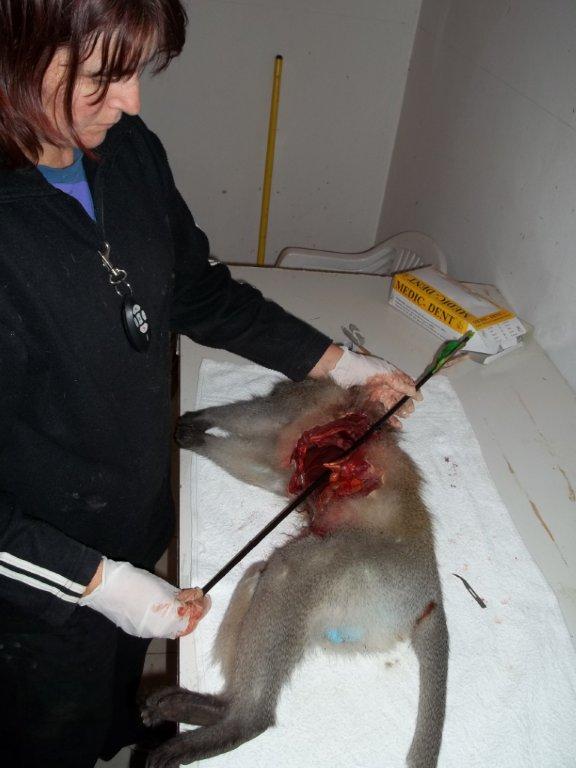
Last weekend we had the sad task of capturing a handsome young adult male Vervet monkey who was the tragic victim of some morally retarded scumbag who thought he could prove his dubious manhood by shooting an arrow into the body of an unsuspecting monkey.


One can only imagine the pain and anguish suffered by the monkey as the arrow smashed through his body then protruded obscenely from either side, sharp point at one end and gayly coloured feather flights at the other. To watch that monkey in the last hours of his life as he struggled to breath with one collapsed lung and his body shaking from the effects of massive infection, getting weaker by the minute and struggling more and more to hold tight and not fall to the ground far below, is an experience I would hope to erase from my memory but never will.


We can only hope that someone who knows who this coward is will have the courage to contact us and provide the information we need for an arrest and conviction. Nothing would give me more pleasure than to see this despicable person thrown into jail and subjected to whatever might await him there.


As of today the reward offered for information leading to an arrest and conviction has been increased to R12 000 .


Following below is a statement sent through to the South Coast Herald for inclusion in an article published this week about the shooting and subsequent death of this monkey:


"On Saturday evening we were alerted to the plight of a male Vervet monkey in Uvongo. He had been shot through with an arrow from a bow, the arrow penetrating his chest from the left next to his shoulder, and protruding from his abdomen on the right.

The monkey was high in the branches of a dead tree and rather than disturb him at the risk of losing him in the failing light, we decided to return the next morning to dart him with a sedative and catch him that way. We were told that he had been in that tree for at least two days. It was obvious from his labored breathing and the tremors racking his body every now and again that he was in a bad way.

We returned on Sunday and after some effort managed to sedate him and catch him. Unfortunately he died a few minutes after capture. Close inspection and a post mortem at the vet showed that the arrow had passed through the left lung, through the diaphragm and through his liver before exiting the right abdominal body wall.

Severe peritonitis had set in and this monkey suffered terribly before eventually dying from his injuries and the related infection.

It should be stated that this is the fifth monkey that we know to having been shot with an arrow along a sixty kilometer section of the South Coast, stretching from Scottburgh to Uvongo. (Scottburgh – 1 adult male, Pennington – 1 adult female, 1 adult male, Uvongo – 1 adult male, Oslo beach – 1 adult unknown gender).

Most South Coast residents we have spoken to are incensed at this cruelty and are quick to point out this must be the work of a few socially dysfunctional individuals. It is certainly not representative of the attitude of most South Coast residents to monkeys. Even those who consider monkeys a pest and a nuisance would not want to see them injured.

Shooting or in any other way injuring monkeys is an offence in terms of both the provincial conservation ordinance and the national Animal Protection Act, and contravention of these laws carries heavy penalties, which could include both a fine and a jail sentence.

Perceptions that monkeys are breeding out of control are totally wrong. Every troop that we monitor is actually decreasing in size from one year to the next as their habitat is degraded and they have to spend more and more time in urban areas, facing the threat of motor vehicles, dogs, electrocution on high voltage power lines, razor wire, people with pellet guns, paintball guns and catapults, poison, and much more. These cause far more fatalities than natural predators ever did.

Monkey Helpline appeals to members of the public to keep a look out for these ruthless killers of monkeys. We believe that all these cases are related, either carried out by the same person or by a small group of two or three working together. We would like to see a public comment and denouncement of these arrow killings made by the archery/bow hunting fraternity, but their silence has been deafening. This leaves the impression, expressed by many who have contacted us, that these cruel killings are condoned by the archery and bow hunting fraternities.

Anyone with information about any of these shootings can contact Monkey Helpline on 082 659 4711 (Steve) or 082 411 5444 (Carol), or on
steve@animalrightsafrica.org, on carol@animalrightsafrica.org . All information will be treated with utmost discretion and there is an R11000 reward for any information that leads to the arrest and conviction of the perpetrator or perpetrators."


Ends.


Pics:


Top - The monkey sits forlornly and in terrible pain on a Strelitzia leaf, the arrow clearly visible.


Second down - Carol holds the sedated, dying monkey upright in an attempt to assist his laboured breathing.


Third down - Checking for a heart beat - in vain.


Bottom - Our regular vet, Dr Kerry Easson, does the post mortem to assess the damage causd by the arrow.

Friday, 27 August 2010

Ever so "Flippin' Cute"

Monkey Helpline blog readers will recall the little Vervet monkey that Carol was holding close in the blog posting of 16 August, “Monkeys still in harm’s way”. Since named “Flippin’ Cute”, because he is such an amazingly affable and bright little chap who holds no grudges against humans in spite of the despicable and cowardly way he has was attacked by some pellet gun-wielding low-life, he has made an amazing recovery.

In addition to being shot three times into his small body, of which at least one pellet went into his chest, he also sustained a badly fractured skull, probably after falling out of a tree or off a roof when he was shot (top pic shows just how swollen Flippin' Cute's eyes were after the trauma to his head).

Now both eyes are completely open and he has perfect vision (centre pic). There does not, at this stage appear to be any brain damage in spite of the severe concussion he suffered. He has an amazing appetite and already I am trying to convince Carol that he is a tad plump! And he is ever so cute!!

Evenings, whilst Carol is doing admin work he sits next to her on the table with a bowl of mixed food and chomps away to his heart’s content. And he watches TV with a real interest (bottom pic), responding to various things he sees, especially the animals on Animal Planet. He was terrified by a big dog even before it barked, watched curiously as a cat was treated by a vet, and then jumped into Carol’s arms and hid his face in her jersey when a turkey gobbled.

He is uncharacteristically afraid of other small monkeys and so he is being introduced slowly to two other monks of about the same age. It is important that he keeps in touch with his monkey-hood because we will make every effort to reunite him with his troop and his mother. If we don’t succeed in doing this he will be bonded into a troop of monkeys being prepared for rehabilitation and release. Sadly, at the time we rescued him he was alone with no other monkeys around, which means that his mother had abandoned him after he was injured, or else she too had been shot and was unable to stay with him. Quite possibly she is dead! Healthy mother Vervets don't easily give up on their babies!!

Let’s hope we get to see Flippin’Cute running back into his mother’s arms – and Carol’s tears will be a mixture of sadness and joy!

Saturday, 31 July 2010

About a month ago, good friend Tracey Hartley, well known in the local animal care community for her efforts in helping feral cats, and equally well known for assisting in the finding of good homes for dogs and cats needing a “forever home”, responded to my call for assistance with a baby, eight month old Vervet monkey run over in Marine Drive, Umhlanga.

Tracey rushed to the scene of the accident, picked up the comatose baby whilst fending off the aggressively protective efforts of the mother Vervet monkey, and rushed to our vet where we met her.

Suffering severe concussion, a cracked scull and a severely damaged left eye, young Bazil, as the monk was named, came home to the awesome care of Carol and Jenny. Sadly Bazil lost the sight in his left eye (clearly visible in the pic of Bazil below) but made such good progress that last week, four weeks after Tracey rescued him, we took him back to Umhlanga in the hope of finding his troop and returning him to his mother.

Bazil’s alertness and interest in his surroundings when we arrived in Umhlanga convinced us that he knew we were near his home and his family. He had known the fresh smell of the sea from the day he was born.

We had no luck finding his troop and we were forced to take a very unhappy Bazil home with us. But before we left we chatted to the regular car guard at the spot where Bazil had been run over and he told us that Bazil’s troop visited the adjacent park every day. We left our card and he promised to call us the moment he next saw the troop.

Two days later we got the call and rushed down to Umhlanga with Bazil. The car guard, whose Rwandan name I could not for the life of me grasp, no matter how many times I asked him to repeat it, ran ahead of me to the other side of the park and pointed to the monkey footprints in the sand. Lots of footprints, but not a monkey in sight! In response to my question as to which way the monkeys were moving he pointed across the road and up the hill. Thanking him we started systematically driving up and down the roads in the area where we hoped to find Bazil’s troop. Luck was on our side and ten minutes later we encountered the lazily foraging troop not far from where we had started our search.

We followed our usual, very successful, process when attempting to return a young monkey to his/her troop and once convinced that this was definitely Bazil’s troop, and that his mother really wanted him back, we released him from the transport cage. Despite the fact that we have done countless returns like this, every one carries with it the same initial trepidation that turns to elation when the baby is back with its possesive mother

Just then I received another rescue call, unbelievably from a mere 500 meters away. I left Carol and Jenny monitoring Bazil’s return to his troop and rushed to the rescue. There I found a very sick-looking mature female Vervet with her seven-month-old youngster playing around her. She was obviously very ill and it took very little effort to catch her as she tried vainly to escape my net by running towards the edge of the roof as I chased after her.

Quickly back to Carol and Jenny who were happily videoing and photographing Bazil being groomed by some of his 'Class of 2009' troop-mates and an older sister. It took no time to convince them of the urgency with which we had to get the sick Vervet to our vet and they hastily bid Bazil goodbye and good luck and off we rushed. Tracey met us en route to the vet and confirmed that this monkey was from the small troop that visited her flat every day. Tracey knew this monkey well. The old girl had been coming to her for a snack every day for years, including that very morning.

At the vet we were horrified to see that the monkey was bleeding heavily from her side and was close to losing consciousness. “Horrified”, because when I had caught her there was not a drop of blood visible on her body and my initial, layman’s “diagnosis” was that she had been struck by a car or had possibly eaten some human medication or poison. I could almost say “no such luck”, because a quick check found two telltale small holes in her side and an x-ray confirmed that there were two pellets in her chest. Even though she was already close to death Kerry, our vet, decided to euthanise her - an act of kindness after such a vicious assault!

I called Tracey and gave her the sad news. She was devastated! Her letter that she subsequently sent to the local Northglen News, and which was published this week, follows below and says all that needs to be said:

“My husband and I were absolutely devastated to hear that our dear One Eye Mother monkey was shot yesterday and had to be euthanased. She was such a harmless old girl, she would visit our flat almost every day and would calmly sit and attend to all her children. Not only did she take excellent care of her own babies, but was also a foster Mom to two others, whose Mom's had met their fates at the cruel hands of humans in the area! Steve from Monkey Helpline & I had been planning to catch her and sterilise her, as we felt that she was getting on in life and already had enough to deal with, without having to care for another new baby. Unfortunately she was senselessly murdered before we could put that plan into action. We will miss you One Eye, but I am sure that your little band of children who relied on you for love and protection, will miss you more!

Deeply saddened!
Tracey & Dalton Hartley
Umhlanga”

Nothing we do or achieve will bring back this old monkey, nor will it change the fact that she died frightened and in pain, distraught at being separated from her baby who, after seeing his dying mother caught and boxed, was last seen running terrified after the rest of the troop, some of whom were still visible in the distance. Besides showing us the pellets in her body, the x-ray also revealed that she was, to our relief, not pregnant!

If ever we find the morally retarded scumbag who so callously shot two pellets into that old Vervet, we will make every effort to have him arrested, charged and punished to the full extent that the law permits. And hopefully, like the idiot who was arrested last week after shooting a “pet” baby Vervet in front of the children in whose home the little monkey was being kept, he will spend at least one night in jail.

If any good can come from the cruel death of this old Vervet, then it must be that we are driven to even greater effort to expose the horror of pellet gun related cruelty that is daily perpetrated against monkeys and other animals, and that our efforts result in more arrests and successful prosecutions of offenders, more stringent controls on the acquisition, ownership and use of pellet guns, and greater understanding on the part of the public about the dangers of pellet guns!

Wednesday, 28 July 2010

Freedom

This posting is devoted to a few of the many positive outcomes of our efforts to help monkeys, and believe me, there are many. It is our optimism with every rescue we are called out to that there will be a happy ending, and for us that translates very simply to being able to release the rescued monkey back to where it was living with its troop before we captured it.

Unfortunately, the reality of monkey rescues is all too often sketched in blood on the stark canvas of human intolerance, cruelty, indifference and speciesism. And the upshot of this is that when we write our blog we are frequently angry, heartbroken, bewildered and frustrated. So, more often than not we find ourselves recounting the tragedies of our daily callouts, not because we thrive on doom and tragedy, but because we believe that unless the public knows exactly what is happening to monkeys in this increasingly monkey-unfriendly world, we won’t get the support we need to make a positive difference for monkeys and other animals who all share this fragile planet. Scattered throughout the dark pain and suffering there are bursts of light that recharge our emotional batteries and keep us going in the belief that every rescue has some good in it, even if that “good” is the humane taking of a tortured and doomed life. But, there are happy endings, inspirational endings, none more so than those recounted here.

During the third quarter of 2009 we rescued two adult male Vervets who had each suffered severe, life-threatening injury to their left leg (primates have arms and legs).

Accacia, the male rescued in Westville and named after the road where he was trapped, had an ugly, painful wound into his left ankle and was unable to use that leg at all.

Michael, rescued in Mkuhla Road, Glen Anil, had survived electrocution on municipal electricity supply lines but the severity of the damage to his lower left leg meant that it would only be a matter of time before he lost the damaged portion of the leg, which would include his left foot.

Both monkeys had contracted severe infection as a result of their injuries.

Our daily monkey dealings have shown us that there are many monkeys who have lost all or part of a limb and survived without the benefit of human intervention and the miracle of modern veterinary care. But we also know that many get infection in similar injuries and suffer terribly before they die. It is up to us to judge each case on its individual merits and, given the extensive rescue, treatment and care experience we have gained over the past fifteen years, to take the action we deem appropriate. So, both Accacia and Michael were trapped and taken to our vet for assessment and necessary treatment.

The vet decided that Accacia’s left leg should be amputated two-thirds up the thigh due to the physical damage and severe infection in both muscle and bone.

Michael’s electrocution-damaged lower leg shriveled and eventually dropped off. Fifteen-year old Monkey helpline volunteer, Shannon Wood, nearly fainted when she discovered Michael’s foot on the bottom of his cage when she was helping with cage-cleaning in our “monkey high- care”.

So now we had to adult male Vervets in our care, each having lost the use of their left leg. Initially we had been certain that both monkeys, each with only three fully functional limbs, would have a good quality of life in a local Vervet sanctuary while they were being assessed for possible release, but that option failed to materialize as the sanctuary had reached capacity and could not accommodate any more adult male Vervets. Direct release became the only option. After seven months with us, a number of those spent in our large outside exercise cages (top pic shows a fit looking Accacia in the exercise cage), both Accacia and Michael were the picture of health. They were fit and strong and able to use their one leg as if they still had two. But we only decided that release was worth the risks after lengthy consideration of all the possible outcomes and much pestering of our primate-knowledgeable friends for their thoughts and advice.

Came the day of the release and much excitement accompanied our catching and boxing of the two boys in preparation of transporting them to their respective places of original rescue capture.

We took Accacia to the very garden where we originally caught him, and the moment the box was opened he sped to freedom, no doubt convinced that the months of captivity spent plotting and planning his escape had suddenly and unexpectedly borne fruit (second from top pic shows Accacia racing back to freedom).

Michael’s release was equally heart-warming as he too sped from the box to freedom (bottom pic), a freedom which to him seemed momentarily to have been thwarted by a palisade fence he must have slipped through easily many times before. But months of five-star meals had added a few centimeters to his girth and he was brought to an abrupt, if very brief halt, before some strenuous wriggling got him through and he could lope casually into the adjacent, unfenced garden and climb easily to the top of a big tree from where he could survey a territory last seen seven months before, but still remembered in every minute detail.

We had told a number of monkey-friendly people living within the territories of Accacia and Michael about the release of the two and asked to be notified of any sightings. To our delight we received news of sightings within days and continue to receive frequent, positive feedback about the activities of both Michael and Accacia.

Three weeks after the release, we had the heart-stopping experience of having Accacia cross busy Blair Athol Road right in front of us in 5 ‘o clock traffic, only about one monkey minute from our house where he had spent the previous seven months. Could it be that he was missing the food and security of life with Carol in the Monkey helpline “high-care” and was trying to find his way back to us? That question was answered two days later when, going down to feed the monkeys in the outside enclosures, we found a contented looking Accacia on top of what had been his exercise cage (a jail by any other name…) for three months.

What would happen if he was confronted by adult males from our resident troop of Vervets? We got the answer a few days later when we watched, enthralled and in trepidation, as Accacia was challenged by one of the young adult males scouting a safe route for his fellow troop members. Being a young adult himself, Accacia survived the encounter and those that followed on subsequent days, having some ugly but not life threatening injuries inflicted on him by the bigger, stronger males.

A week after his first encounter with the troop he had challenged daily for three months from the safety of his cage, Accacia was accepted into the troop with which he now visits our garden daily ( pic third from top shows a comfortably free-again, banana-eating Accacia in our garden).

As for Michael, he continues to enjoy the company of the troop he was a part of when we rescued him. One lady called to say she sees him often and recently said he was “running like the wind in the tree tops”. A few weeks ago we received a rescue callout that took us to Huckleberry Road in Glen Anil. On our arrival I realized that we were just over the hill from where we had released Michael. I asked the caller if she had seen a male monkey with his left foot missing. She laughed and told us to go and look in the trees behind her house. There, sitting casually on a branch surrounded by a collection of other Vervets, was Michael. He was so well and looked as if he had never spent a day away from his troop. And we knew he had been unconditionally accepted back into his troop when the alpha male walked along the branch Michael was sitting on, brushed past him and continued on his way to another tree without giving Michael a second glance. I’m not ashamed to say I had a tear of joy trickle down my cheek and when I looked across at Carol she too was teary-eyed with happiness and relief at seeing Michael so comfortably back where he belongs.

To end on a humorous note, last week we received a call from an elderly lady living in Cypress Road, Glen Anil. She said she was terribly concerned about a badly injured monkey who was in her garden. I asked the usual questions and learnt that the entire troop was there in her garden, including a big male whose foot was missing. Would we please come and catch this poor “suffering” monkey, and would we have to euthanise him? I asked if it was his left foot missing? Yes! Was the “injured” leg bleeding? No! Other than the missing foot, did the monkey look healthy? Yes, very! This was definitely Michael, and the lady was delighted to have met him.

I started this blog post intending to share at least four happy releases with you, but the others will have to wait for another posting, otherwise I'll be up till 3am again.

What the release of Michael and Accacia has taught us is that, given the chance, Vervets can survive, unconfined, with disabilities resulting from natural and man-made causes, even if those disabilities are as severe as the full or partial loss of a limb. We owe it to them to give them every chance to do so!