Sunday, 19 September 2010

YOU CAN HELP US HELP MONKEYS


“I own a thatched property in Marina Beach, lower south coast. My roof is being systematically destroyed by a troop(s) of monkeys. When I contacted my insurance broker about a claim to effect repairs, he told me that monkeys are classed as vermin, so I would not be able to claim for the damage/repairs. Is this the case?If monkeys are vermin, is it legal to poison them like rats & mice? I understand the need for conservation of nature in the area. However I can't afford the bills to continually repair my thatch”.

Above is an extract from a letter I received this past week, and it so clearly illustrates the stupidity that informs the thinking of a small but dangerous number of morally retarded cretins whose actions are having a terrible impact on the lives of many monkeys throughout KwaZulu-Natal and other parts of South Africa. What kind of twisted mind are we dealing with, who even considers poisoning as an acceptable means of resolving his problems with monkeys?

Certainly in KZN monkeys are not classified as vermin and it is most definitely illegal to “poison them like rats and mice”! Fact is that monkeys are protected nationally by the Animal Protection Act and provincially by the KZN Nature Conservation Ordinance. They are also protected by the efforts of organizations like Monkey Helpline, various animal protection groups, and by a not insignificant body of ordinary people who feel very strongly about the welfare of monkeys and other animals.

Which brings me to the point of this blog post, namely, to show that without the support of the animal-caring public, Monkey Helpline cannot carry out its mandate to educate, rescue, provide veterinary care, post-veterinary care, rehabilitate, release or provide life-long sanctuary.

Yes, without this support Monkey Helpline would not even have known about most of the three-hundred and twenty-seven rescue callouts we responded to between January 1 and June 30 this year. These calls originated from across the age, race and gender spectrum, from people representing all sectors of our society, but all of them with three things in common – decency, integrity and compassion!

And if this seems like a high number of monkeys in need of our help, believe us when we tell you that it represents only a fraction of the total number of monkeys suffering and dying in places where no caring person gets to see them and do something to help. If Monkey Helpline rescue figures are extrapolated to the total area traversed by troops of monkeys throughout KwaZulu-Natal every day, then a staggering number of monkeys are being injured or killed here every year. Judging by the non-scientific observations by Monkey Helpline rescuers of the situation as it affects urban Vervet monkeys, it is not unrealistic to fear the extinction of these little animals within the lifetime of our current generation.
(The pics exhibited in this posting show just how deranged a person can be. Top pic shows a beautiful adult male Vervet with an arrow shot from a bow through his arm. Next pic shows the x-ray of his humerus shattered by the arrow just above the elbow joint. Bottom pic of this monkey after the broken arrow was removed from his arm, with veterinarian, Dr Kerry Easson holding the three pieces of arrow.)

If you want to make a real difference for monkeys in South Africa, you cannot do better than to show your support for our efforts to help them. We know from our day to day experiences, and the people we meet and talk to, that there are far more people who care about the welfare of monkeys than there are people who dislike and loathe monkeys to the extent of harming or killing them. Unfortunately the pro-monkey people are not as vociferous about their feelings as are the anti-monkey people. We need to let these anti-monkey cretins know that they are a small minority whose aggression and violence towards monkeys will not be allowed to go unchallenged.

So, how do YOU show the monkeys that you are batting for them?

Its pretty simple. Arrange with your kids' school for Monkey Helpline to come and do a Power Point-supported talk to pupils and teachers. Volunteer to work at the Monkey Helpline “high care” and recovery facility. Distribute Monkey helpline leaflets. Become a "monkey monitor”. Help us at our Essenwood Market table on Saturdays between 8.30am and 2pm – an hour or two whenever you can, would be a great help. Become a Monkey helpline member, donor or sustainer. This and so much more – contact Steve or Carol on 082 659 4711 or 082 411 5444 respectively or email us at steve@animalrightsafrica.org .
Remember, without your help and support we cannot continue helping monkeys in distress. THE MONKEYS NEED YOU!!!

Friday, 27 August 2010

Ever so "Flippin' Cute"

Monkey Helpline blog readers will recall the little Vervet monkey that Carol was holding close in the blog posting of 16 August, “Monkeys still in harm’s way”. Since named “Flippin’ Cute”, because he is such an amazingly affable and bright little chap who holds no grudges against humans in spite of the despicable and cowardly way he has was attacked by some pellet gun-wielding low-life, he has made an amazing recovery.

In addition to being shot three times into his small body, of which at least one pellet went into his chest, he also sustained a badly fractured skull, probably after falling out of a tree or off a roof when he was shot (top pic shows just how swollen Flippin' Cute's eyes were after the trauma to his head).

Now both eyes are completely open and he has perfect vision (centre pic). There does not, at this stage appear to be any brain damage in spite of the severe concussion he suffered. He has an amazing appetite and already I am trying to convince Carol that he is a tad plump! And he is ever so cute!!

Evenings, whilst Carol is doing admin work he sits next to her on the table with a bowl of mixed food and chomps away to his heart’s content. And he watches TV with a real interest (bottom pic), responding to various things he sees, especially the animals on Animal Planet. He was terrified by a big dog even before it barked, watched curiously as a cat was treated by a vet, and then jumped into Carol’s arms and hid his face in her jersey when a turkey gobbled.

He is uncharacteristically afraid of other small monkeys and so he is being introduced slowly to two other monks of about the same age. It is important that he keeps in touch with his monkey-hood because we will make every effort to reunite him with his troop and his mother. If we don’t succeed in doing this he will be bonded into a troop of monkeys being prepared for rehabilitation and release. Sadly, at the time we rescued him he was alone with no other monkeys around, which means that his mother had abandoned him after he was injured, or else she too had been shot and was unable to stay with him. Quite possibly she is dead! Healthy mother Vervets don't easily give up on their babies!!

Let’s hope we get to see Flippin’Cute running back into his mother’s arms – and Carol’s tears will be a mixture of sadness and joy!

Wednesday, 25 August 2010

RIP, Grumpy Face!


Sometimes I wake up and I just know it’s going to be one of “those weeks”.

How do I know this? I don’t know, but I do. Experience has taught me that some things, though not many, it is better I do not know!

Anyway, it was Monday morning, August 16th, and “one of those weeks” started! Not the busiest week we’ve ever had – just uncoordinated and bitty! Rushing at the last moment to do a school talk that hadn’t been confirmed until two minutes previously. This after spending the time before and after dropping kids at school discouraging the resident Juvenile Crowned Eagle from honing her hunting skills on any of the twenty-one cats who have found a home with us. Perched high in the old Flamboyant tree (top pic), she is a magnificent animal and we are really privileged to have her spend so much time in our garden, even if the monkeys recovering in the outside cages don’t appreciate her presence in the same way we do. In fact, harsh as it might seem, her visits are good for our juvenile monkeys who were rescued as orphans, because they have gained very valuable life skills from her presence, as our older monkeys, who know what a threat Crowned Eagles are to Vervet monkeys, saturate the upper end of the valley with alarm calls for as long as the eagle is in sight. All the younger monkeys hide in the back of their cage in silence and won’t even peep out until the older monkeys sound the “all clear”.

Usually our day starts with cleaning cages and feeding monkeys. We get as much done as possible before taking kids to school, and hope like crazy that we don’t get an urgent rescue call before we have the time to get home, finish what cleaning and feeding still needs doing and then jump into the shower or bath.

An uneventful Tuesday was followed by a hectic Wednesday. Dropping kids at school early enough to be able to negotiate Pinetown’s early morning traffic so that we could get to a school talk by 7.50, we got a call from monkey-lover, Brenda, about a monkey attacked by a dog in the garden of a Manor Gardens home at the upper end of her road. So, whilst rushing to rescue the monkey, we called and rescheduled the school talk for next week. Arriving at the scene of the incident we saw that the injured monkey was a magnificent male from the troop that Brenda feeds at her home every day, and from which we had previously, on separate occasions, trapped and treated two members in need of urgent veterinary attention. During the time spent trapping the monkeys at Brenda’s house, Carol had got to know this particular monkey very well, even naming him “Grumpy Face”. By the time we arrived at the house where Grumpy Face had been attacked, he had already climbed a tree and was just out of our reach. Seriously injured after being bitten into the chest by the dog, a large male Rhodesian Ridgeback, he was still mobile enough to avoid capture as I climbed the tree in an attempt to get close enough to net him. So, darting with a sedative was the only way to go!

Enter Senior Inspector Dougie Du Plessis of the Durban SPCA, who arrived as soon as he could after we called him, considering he had to traverse Durban during morning rush-hour traffic. A well-placed dart galvanized Grumpy Face into action and he clambered painfully into the highest, thinnest branches of the tree, with all the rescuers and volunteers who had gathered, surrounding the tree to block his escape should he decide to try and get out of the tree. But he had no such intentions and just clung to the branches as if his life depended on it, which it did, trying to find a comfortable position to ease the pain that must have been swamping his body with every breath and movement.

After what seemed an eternity we all agreed that he looked drowsy enough for me to climb the tree and attempt a net capture. Not that easy because of the way a Cedar tree grows its branches, but eventually, after abandoning the net, with Carol and Dougie and the volunteer team below ready to catch the monkey if he fell, I managed to snare his tail using a catch-pole, and with him still having plenty of fight left in him in spite of his injuries and the sedatives, I guided him down the tree as gently as I could, making sure of keeping clear of his lethal canines!

Brenda just broke into tears at the sight of one of her beloved monkeys so injured and close to death. We got Grumpy Face to the vet as fast as we could, but sadly he died literally as we arrived there. What a tragedy to see such a magnificent animal die so senselessly (bottom pic shows a heart-broken Carol holding Grumpy Face just after he died). With the dog’s owner having initially claimed that the monkey attacked his dog for no reason, though Carol very quickly put him right on that by explaining that monkeys only ever bite dogs in self defense and never just attack a dog because they are vindictive or having a bad day, we were left wondering whether there was another dog- bitten monkey to whose defense Grumpy Face had rushed, bravely sacrificing his own life in the process.

With most of his troop in close attendance during the entire rescue operation, we certainly had not seen any other injured monkey, and a post-rescue search also yielded nothing. What we did see and which touched the hearts of all who had gathered, was the pregnant female monkey who stayed close throughout the whole incident, calling gently to Grumpy Face in an attempt to entice him to follow the troop, which, for the safety of all its members usually only stays in the same place for as long as is necessary and must keep moving throughout its territory. It is a sobering experience to watch a troop of monkeys milling around anxiously as they delay their departure in the hope that their injured troop-mate will regain the strength needed to follow them. But eventually they do leave and in this case the loyal female was forced to leave too, as the safety of her unborn baby and that of her one year–old remained her primary responsibility!

Look out for the upcoming separate blog postings in which I’ll share with you the collection of incidents that coloured the remaining days of the week!

Monday, 16 August 2010

Monkeys still in harms way

The reaction from blog readers to the previous blog about the pregnant female from Hillcrest who had to be euthanised because of the damage caused to her body and her unborn baby by the five lead pellets that had been shot into her was quite phenomenal. Readers were outraged by the brutality of the unwarranted attack on a pregnant monkey and all wanted to know if it would be possible to identify and prosecute the guilty person/persons.

Yes, it is possible to identify and prosecute the scum who would be so callously cruel to an innocent animal. But only if we get a sworn statement from an eye witness. If it seems that simple, it isn’t!

(Top pic - Carol gets up close and personal with a ten-month old baby Vervet, rescued this week, who already has three, yes three, pellets in his small body. And he also has a multi-fractured skull, hence the swollen shut eyes, after falling from a high tree as he tried to get away from whatever was causing the pain that was wracking his little frame.)

Every time we rescue a monkey who has been shot with a pellet gun we immediately flood the surrounding area with our “pellet gun leaflet”, which highlights the suffering associated with injuries caused by lead pellets, sets out the nature of the criminal offence of discharging a pellet gun in a residential area as contained in the relevant section and paragraphs of the Firearm Control Act, and calls on residents of the area to report any pellet gun abuse by neighbours to us.

Inevitably we get one of two responses, sometimes both:

- Defensive and indignant calls from individuals who think that they are the only one who found our leaflet in their post box and then claim that they are being set up by a neighbour who doesn’t like them. Often this call is from the very person who has already been pointed out to us by neighbours as the shooter!
- Animal-, even monkey- loving people who claim that one of their neighbours shoots at monkeys and other animals with a pellet gun.

Whichever response we get, it is usually pretty simple to identify who the shooter is. What isn’t that simple is convincing most witnesses to go to their local police station and make a sworn statement about what they have seen. But why this reticence to take the crucial step that will go a long way towards getting the suspect arrested and prosecuted?

(Second pic - A beautiful female Vervet, heavily pregnant, shot twice with a pellet gun this week. One pellet entered her abdomen and also killed her unborn baby. She suffered terribly and was found as she died, bent over with her face in her hands and the grimace etched on her face showing the excrutiating pain she endured for at least a week after being shot).

Mostly the answer from witnesses is that they don’t want to develop bad relations with the shooter (neighbour). Or, the shooter is “well connected” with the local police and will not get charged. Or, that the shooter is a “dangerous” person who might “do something” to the witness or even kill the witness’s own pets. And more…

Fact is that without the statement from the witness our hands, and those of the law enforcers, are tied. When we impress upon the witness how important their statement is, they usually say that they will definitely make a statement the next time they see the shooter using the pellet gun. That’s great, but then, as I point out, they must accept that they are also saying that another, and another, and another monkey will be shot before they are prepared to report the shooter and follow this up with a sworn statement to the police - just so that they don’t piss off their neighbour and spoil their “good” neighbour relationship. Get serious! Who in their right mind wants to have a good relationship with a moronic neighbour who you know is cruelly shooting monkeys and/or other animals? Would you want to maintain a "good" relationship with a neighbour who you discover is physically or sexually abusing children? I think not!

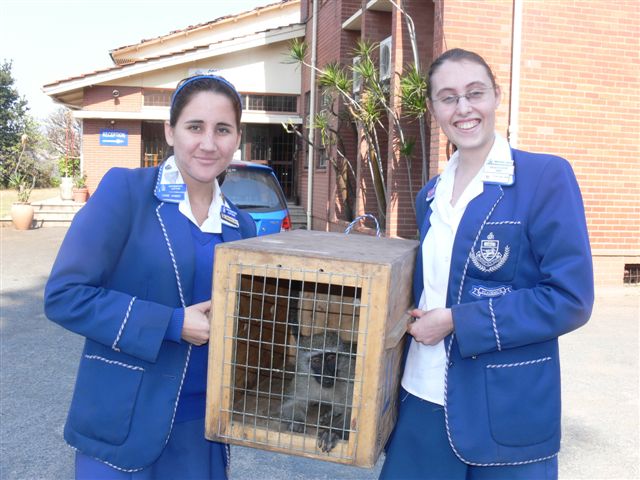
(Third pic - Grosvenor Girls' High School learners, Louise Joubert (left) and Rachel Van Rensburg, hold the pregnant female Vervet, paralysed in her lower body, who they watched over and fed in the school grounds last week until Monkey Helpline arrived to rescue her).

But we don't tell witnesses to have the guts to do the right thing. We realize that just phoning us is already a big step and we really appreciate this. We are very polite and we ask them nicely to think about it very carefully and then to let us know if they change their minds because they have it in their power to save more monkeys from horrible suffering and death.

(Bottom pic - The pregnant Vervet rescued from Gosvenor Girls' High School, paralysed by a lead pellet that smashed her spine, about to be taken to the vet to be euthanised).
And in the meantime, whilst they are making up their minds, and maintaining good relationships with the monkey murdering neighbour, we carry on the grim task of picking up the dead and dying monkeys!

"The world is a dangerous place to live, not because of the people are evil, but because of the people who do nothing about it". Albert Einstein


Wednesday, 04 August 2010

Win some! Lose some! Too many lost!

On a daily basis I am appalled by the callous indifference shown to Vervet monkeys by a small, morally dysfunctional group of people living in those residential areas also frequented by Vervet monkeys.

Recently a local newspaper published a number of letters from people antagonistically inclined towards the presence of monkeys around their homes. Fears about monkeys possibly attacking babies, spreading rabies and just being monkeys were graphically and emotively presented. This in spite of the fact that Monkey Helpline has for years been educating people regarding the truth about monkeys and debunking the myths that have lead some people to erroneously see them as vermin, carriers of rabies and being prone to attacking and severely injuring adults, children and dogs, even cats on the odd occasion!

Fact is that in KZN monkeys are NOT classified as “vermin” – they are protected nationally in terms of the Animal Protection Act, and provincially in terms of the KZN Nature Conservation Ordinance. They do NOT attack people or their pets, only biting when they are themselves attacked by dogs or if a person tries to catch or hurt a monkey. They are NOT carriers of rabies and there has NEVER been an officially recorded case of a rabid monkey in South Africa. There is NO monkey “over-population” or “population explosion” as so many uninformed people are quick to proclaim when calling for monkeys to be culled or captured and relocated. On the contrary, with so many urban monkeys dying daily from injuries sustained when hit by motor vehicles, attacked and bitten by dogs, shot with pellet guns, electrocuted on power lines, caught in razor wire, poisoned, trapped and snared, these deaths, including those of monkeys dying from injuries sustained during inter- and intra-troop fights which are particularly vicious due to the stress the monkeys are under because of persecution and habitat destruction, are far higher than any population can sustain and certainly far higher than they would suffer from natural predators.

As distressing as it is to deal with the daily consequences of violence against, and indifference to the needs of, monkeys it is also heartwarming and encouraging to know that there are far more people who care about monkeys and want to protect rather than harm them. Monkey-haters are a small, ethically retarded minority of the population but sadly their negative impact on the safety of monkeys is substantial. For example, this past week alone just in Hillcrest, pro-monkey residents assisted the Monkey helpline with rescuing three Vervet monkeys horribly injured after falling victim to human violence.

The first was a young male monkey caught in a snare set on a garden wall in the centre of residential Hillcrest. The snare, made of unraveled strands of bicycle brake cable, was set on top of a pre-cast wall used daily by a troop of monkeys. It was attached to a razor-wire bracket so that when the monkey was snared just above his left ankle, he also injured himself horribly on the razor-wire as he thrashed about trying to escape, even breaking some teeth on the razor-wire as he bit at this thing that was hurting him so much every time he moved (second pic down shows the vet removing a broken tooth from the monkey's jaw). Fortunately, a neighbour saw him struggling and called the Monkey Helpline. We rescued him and with the excellent veterinary treatment received from our vet at Riverside Vet Clinic, Dr Kerry Easson, we will soon be able to free him back to his troop.

The second was a beautiful, mature adult female rescued from a residential complex, also in central residential Hillcrest. Monkey Helpline was called after a caring resident saw what she thought was a dead monkey lying on her lawn. As she approached the monkey she saw movement and realized it was still alive. We rushed the monkey to our vet where an x-ray revealed five pellets in her body (third pic down)). One had passed through her liver causing an enormous abscess which had burst a day or two earlier spewing lethal infection into her abdomen. In spite of a heroic effort by Kerry, which included major surgery to repair pellet damage and flush the infectious pus from her abdomen, she died shortly after she was taken off the operating table. To add to the tragedy was the discovery of a freshly dead, perfectly formed little baby in her womb. It had literally been poisoned to death by the noxious liver abscess (fourth pic down shows mom and unborn baby).

Third was a rear-old little monkey struck by a motor vehicle just a few hundred meters from where the shot female had been rescued the previous day. In spite of the fact that monkeys were visibly crossing the busy road, and responsible motorists were slowing down, it took just one uncaring and unfocussed idiot to race along and right over the young monkey, leaving it for dead in the road and continuing his journey without any concern for the life he had, by all appearances, just ended. Fortunately the incident was witnessed by one of the many monkey-caring families living in the Highway area. They stopped to move the “dead” monkey to the side of the road, as much for its dignity and not wanting to see it squashed by other vehicles as to ensure that more monkeys were not run over as they ran into the road frantically trying to coax their unmoving, bleeding troop-mate to follow them. The actions of these animal lovers actually saved the young monkey’s life because he was still very much alive though deeply unconscious and bleeding profusely from injuries to his lower lip and jaw. Again Kerry’s skill and dedication ensured the monkey’s survival and once his cuts and broken jaw are healed he will be returned to his troop.

These are just three of the many monkeys we have been called out to rescue this past week. I’ll update you on a few more of them in the next blog posting, but one thing that needs to be said is that as much as it is the dramatic rescue effort that ends with a monkey in our carry-box, or wrapped in a towel if it has died, that people notice and support, none of this would be possible were it not for all the amazing people who care enough to phone us when they see a monkey in distress. Without those many phone calls interrupting our lives twenty-four hours a day we would be doing normal day jobs, earning good salaries, having weekends off, going on holiday, and, heaven forbid, maybe even watching an entire Sharks game without having to rush off and rescue a monkey, or one of the many other animals that come our way. Yes, without your calls we would be doing all these things, and every year hundreds of monkeys would suffer or die without any chance of being saved. THANK YOU FOR CARING ENOUGH TO MAKE THAT CALL!

Saturday, 31 July 2010

About a month ago, good friend Tracey Hartley, well known in the local animal care community for her efforts in helping feral cats, and equally well known for assisting in the finding of good homes for dogs and cats needing a “forever home”, responded to my call for assistance with a baby, eight month old Vervet monkey run over in Marine Drive, Umhlanga.

Tracey rushed to the scene of the accident, picked up the comatose baby whilst fending off the aggressively protective efforts of the mother Vervet monkey, and rushed to our vet where we met her.

Suffering severe concussion, a cracked scull and a severely damaged left eye, young Bazil, as the monk was named, came home to the awesome care of Carol and Jenny. Sadly Bazil lost the sight in his left eye (clearly visible in the pic of Bazil below) but made such good progress that last week, four weeks after Tracey rescued him, we took him back to Umhlanga in the hope of finding his troop and returning him to his mother.

Bazil’s alertness and interest in his surroundings when we arrived in Umhlanga convinced us that he knew we were near his home and his family. He had known the fresh smell of the sea from the day he was born.

We had no luck finding his troop and we were forced to take a very unhappy Bazil home with us. But before we left we chatted to the regular car guard at the spot where Bazil had been run over and he told us that Bazil’s troop visited the adjacent park every day. We left our card and he promised to call us the moment he next saw the troop.

Two days later we got the call and rushed down to Umhlanga with Bazil. The car guard, whose Rwandan name I could not for the life of me grasp, no matter how many times I asked him to repeat it, ran ahead of me to the other side of the park and pointed to the monkey footprints in the sand. Lots of footprints, but not a monkey in sight! In response to my question as to which way the monkeys were moving he pointed across the road and up the hill. Thanking him we started systematically driving up and down the roads in the area where we hoped to find Bazil’s troop. Luck was on our side and ten minutes later we encountered the lazily foraging troop not far from where we had started our search.

We followed our usual, very successful, process when attempting to return a young monkey to his/her troop and once convinced that this was definitely Bazil’s troop, and that his mother really wanted him back, we released him from the transport cage. Despite the fact that we have done countless returns like this, every one carries with it the same initial trepidation that turns to elation when the baby is back with its possesive mother

Just then I received another rescue call, unbelievably from a mere 500 meters away. I left Carol and Jenny monitoring Bazil’s return to his troop and rushed to the rescue. There I found a very sick-looking mature female Vervet with her seven-month-old youngster playing around her. She was obviously very ill and it took very little effort to catch her as she tried vainly to escape my net by running towards the edge of the roof as I chased after her.

Quickly back to Carol and Jenny who were happily videoing and photographing Bazil being groomed by some of his 'Class of 2009' troop-mates and an older sister. It took no time to convince them of the urgency with which we had to get the sick Vervet to our vet and they hastily bid Bazil goodbye and good luck and off we rushed. Tracey met us en route to the vet and confirmed that this monkey was from the small troop that visited her flat every day. Tracey knew this monkey well. The old girl had been coming to her for a snack every day for years, including that very morning.

At the vet we were horrified to see that the monkey was bleeding heavily from her side and was close to losing consciousness. “Horrified”, because when I had caught her there was not a drop of blood visible on her body and my initial, layman’s “diagnosis” was that she had been struck by a car or had possibly eaten some human medication or poison. I could almost say “no such luck”, because a quick check found two telltale small holes in her side and an x-ray confirmed that there were two pellets in her chest. Even though she was already close to death Kerry, our vet, decided to euthanise her - an act of kindness after such a vicious assault!

I called Tracey and gave her the sad news. She was devastated! Her letter that she subsequently sent to the local Northglen News, and which was published this week, follows below and says all that needs to be said:

“My husband and I were absolutely devastated to hear that our dear One Eye Mother monkey was shot yesterday and had to be euthanased. She was such a harmless old girl, she would visit our flat almost every day and would calmly sit and attend to all her children. Not only did she take excellent care of her own babies, but was also a foster Mom to two others, whose Mom's had met their fates at the cruel hands of humans in the area! Steve from Monkey Helpline & I had been planning to catch her and sterilise her, as we felt that she was getting on in life and already had enough to deal with, without having to care for another new baby. Unfortunately she was senselessly murdered before we could put that plan into action. We will miss you One Eye, but I am sure that your little band of children who relied on you for love and protection, will miss you more!

Deeply saddened!
Tracey & Dalton Hartley
Umhlanga”

Nothing we do or achieve will bring back this old monkey, nor will it change the fact that she died frightened and in pain, distraught at being separated from her baby who, after seeing his dying mother caught and boxed, was last seen running terrified after the rest of the troop, some of whom were still visible in the distance. Besides showing us the pellets in her body, the x-ray also revealed that she was, to our relief, not pregnant!

If ever we find the morally retarded scumbag who so callously shot two pellets into that old Vervet, we will make every effort to have him arrested, charged and punished to the full extent that the law permits. And hopefully, like the idiot who was arrested last week after shooting a “pet” baby Vervet in front of the children in whose home the little monkey was being kept, he will spend at least one night in jail.

If any good can come from the cruel death of this old Vervet, then it must be that we are driven to even greater effort to expose the horror of pellet gun related cruelty that is daily perpetrated against monkeys and other animals, and that our efforts result in more arrests and successful prosecutions of offenders, more stringent controls on the acquisition, ownership and use of pellet guns, and greater understanding on the part of the public about the dangers of pellet guns!

Wednesday, 28 July 2010

Freedom

This posting is devoted to a few of the many positive outcomes of our efforts to help monkeys, and believe me, there are many. It is our optimism with every rescue we are called out to that there will be a happy ending, and for us that translates very simply to being able to release the rescued monkey back to where it was living with its troop before we captured it.

Unfortunately, the reality of monkey rescues is all too often sketched in blood on the stark canvas of human intolerance, cruelty, indifference and speciesism. And the upshot of this is that when we write our blog we are frequently angry, heartbroken, bewildered and frustrated. So, more often than not we find ourselves recounting the tragedies of our daily callouts, not because we thrive on doom and tragedy, but because we believe that unless the public knows exactly what is happening to monkeys in this increasingly monkey-unfriendly world, we won’t get the support we need to make a positive difference for monkeys and other animals who all share this fragile planet. Scattered throughout the dark pain and suffering there are bursts of light that recharge our emotional batteries and keep us going in the belief that every rescue has some good in it, even if that “good” is the humane taking of a tortured and doomed life. But, there are happy endings, inspirational endings, none more so than those recounted here.

During the third quarter of 2009 we rescued two adult male Vervets who had each suffered severe, life-threatening injury to their left leg (primates have arms and legs).

Accacia, the male rescued in Westville and named after the road where he was trapped, had an ugly, painful wound into his left ankle and was unable to use that leg at all.

Michael, rescued in Mkuhla Road, Glen Anil, had survived electrocution on municipal electricity supply lines but the severity of the damage to his lower left leg meant that it would only be a matter of time before he lost the damaged portion of the leg, which would include his left foot.

Both monkeys had contracted severe infection as a result of their injuries.

Our daily monkey dealings have shown us that there are many monkeys who have lost all or part of a limb and survived without the benefit of human intervention and the miracle of modern veterinary care. But we also know that many get infection in similar injuries and suffer terribly before they die. It is up to us to judge each case on its individual merits and, given the extensive rescue, treatment and care experience we have gained over the past fifteen years, to take the action we deem appropriate. So, both Accacia and Michael were trapped and taken to our vet for assessment and necessary treatment.

The vet decided that Accacia’s left leg should be amputated two-thirds up the thigh due to the physical damage and severe infection in both muscle and bone.

Michael’s electrocution-damaged lower leg shriveled and eventually dropped off. Fifteen-year old Monkey helpline volunteer, Shannon Wood, nearly fainted when she discovered Michael’s foot on the bottom of his cage when she was helping with cage-cleaning in our “monkey high- care”.

So now we had to adult male Vervets in our care, each having lost the use of their left leg. Initially we had been certain that both monkeys, each with only three fully functional limbs, would have a good quality of life in a local Vervet sanctuary while they were being assessed for possible release, but that option failed to materialize as the sanctuary had reached capacity and could not accommodate any more adult male Vervets. Direct release became the only option. After seven months with us, a number of those spent in our large outside exercise cages (top pic shows a fit looking Accacia in the exercise cage), both Accacia and Michael were the picture of health. They were fit and strong and able to use their one leg as if they still had two. But we only decided that release was worth the risks after lengthy consideration of all the possible outcomes and much pestering of our primate-knowledgeable friends for their thoughts and advice.

Came the day of the release and much excitement accompanied our catching and boxing of the two boys in preparation of transporting them to their respective places of original rescue capture.

We took Accacia to the very garden where we originally caught him, and the moment the box was opened he sped to freedom, no doubt convinced that the months of captivity spent plotting and planning his escape had suddenly and unexpectedly borne fruit (second from top pic shows Accacia racing back to freedom).

Michael’s release was equally heart-warming as he too sped from the box to freedom (bottom pic), a freedom which to him seemed momentarily to have been thwarted by a palisade fence he must have slipped through easily many times before. But months of five-star meals had added a few centimeters to his girth and he was brought to an abrupt, if very brief halt, before some strenuous wriggling got him through and he could lope casually into the adjacent, unfenced garden and climb easily to the top of a big tree from where he could survey a territory last seen seven months before, but still remembered in every minute detail.

We had told a number of monkey-friendly people living within the territories of Accacia and Michael about the release of the two and asked to be notified of any sightings. To our delight we received news of sightings within days and continue to receive frequent, positive feedback about the activities of both Michael and Accacia.

Three weeks after the release, we had the heart-stopping experience of having Accacia cross busy Blair Athol Road right in front of us in 5 ‘o clock traffic, only about one monkey minute from our house where he had spent the previous seven months. Could it be that he was missing the food and security of life with Carol in the Monkey helpline “high-care” and was trying to find his way back to us? That question was answered two days later when, going down to feed the monkeys in the outside enclosures, we found a contented looking Accacia on top of what had been his exercise cage (a jail by any other name…) for three months.

What would happen if he was confronted by adult males from our resident troop of Vervets? We got the answer a few days later when we watched, enthralled and in trepidation, as Accacia was challenged by one of the young adult males scouting a safe route for his fellow troop members. Being a young adult himself, Accacia survived the encounter and those that followed on subsequent days, having some ugly but not life threatening injuries inflicted on him by the bigger, stronger males.

A week after his first encounter with the troop he had challenged daily for three months from the safety of his cage, Accacia was accepted into the troop with which he now visits our garden daily ( pic third from top shows a comfortably free-again, banana-eating Accacia in our garden).

As for Michael, he continues to enjoy the company of the troop he was a part of when we rescued him. One lady called to say she sees him often and recently said he was “running like the wind in the tree tops”. A few weeks ago we received a rescue callout that took us to Huckleberry Road in Glen Anil. On our arrival I realized that we were just over the hill from where we had released Michael. I asked the caller if she had seen a male monkey with his left foot missing. She laughed and told us to go and look in the trees behind her house. There, sitting casually on a branch surrounded by a collection of other Vervets, was Michael. He was so well and looked as if he had never spent a day away from his troop. And we knew he had been unconditionally accepted back into his troop when the alpha male walked along the branch Michael was sitting on, brushed past him and continued on his way to another tree without giving Michael a second glance. I’m not ashamed to say I had a tear of joy trickle down my cheek and when I looked across at Carol she too was teary-eyed with happiness and relief at seeing Michael so comfortably back where he belongs.

To end on a humorous note, last week we received a call from an elderly lady living in Cypress Road, Glen Anil. She said she was terribly concerned about a badly injured monkey who was in her garden. I asked the usual questions and learnt that the entire troop was there in her garden, including a big male whose foot was missing. Would we please come and catch this poor “suffering” monkey, and would we have to euthanise him? I asked if it was his left foot missing? Yes! Was the “injured” leg bleeding? No! Other than the missing foot, did the monkey look healthy? Yes, very! This was definitely Michael, and the lady was delighted to have met him.

I started this blog post intending to share at least four happy releases with you, but the others will have to wait for another posting, otherwise I'll be up till 3am again.

What the release of Michael and Accacia has taught us is that, given the chance, Vervets can survive, unconfined, with disabilities resulting from natural and man-made causes, even if those disabilities are as severe as the full or partial loss of a limb. We owe it to them to give them every chance to do so!