Monday, 11 April 2011

More "paintball pain".

Oh so sore!


Our previous Monkey Helpline blog post about the effects of paintball guns on Vervet monkeys and other animals inspired my daughter, Kiron, who lives in Gauteng, to send a few pics of injuries she has suffered whislt engaging in paintball games at a paintball range (the only place a paintball should be fired at a living being – other than when used for self-protection against criminals!) At the time of these injuries she was wearing protective clothing...

Looking at these injuries, caused by a paintball gun that is set at the maximum velocity for use at a paintball range, namely, 270 feet per second, you can imagine the damage caused by a paintball fired at around 400 feet per second!! No wonder Mr Macho won’t take up my challenge to let me shoot him with his own paintball gun from a distance of ten meters.


But then I shouldn’t be surprised. People who are cruel to animals really are just cowardly moral retards!


Thanks for sharing your pain with us, Kiron. The pictures speak volumes!

Thursday, 07 April 2011

The "PAIN" in Paintball.

Comment on the use of Paintball guns against animals.

Increasingly we, Monkey Helpline, come across people who tell us that their neighbour or someone they know shoots at monkeys or other animals with a paintball gun. And on a number of occasions when we have done public presentations, so-called animal-friendly people, nearly always males, have told us that they chase away Vervet monkeys or other “ troublesome” animals by shooting at them with a paintball gun. They are adamant that the paintball does not hurt too seriously and certainly won’t maim or kill the animal! We beg to differ, seriously differ!

My response to these Neanderthals is to challenge them to let me shoot them with their own paintball gun from a ten meter distance, and I’ll set the speed at which the paintball is fired. You guessed right – NO TAKERS!! Can’t understand though, because Mr Macho has just told me that the paintball doesn’t really hurt the monkey! We have on more than one occasion rescued monkeys splashed in paint from the paintballs shot at them. We rescued a young monkey (see pic ) with severe concussion after a witness actually saw him being shot against his head with a paintball. He later died from a brain hemorrhage!

The question I always ask is, “Then tell me why, when people play their paintball games, do they wear such serious protection gear”? I see special-impact-lessening vests, helmets, eye protection and much more. I also see the painful injuries people suffer during these games when a paintball hits a less protected part of their body. Looking at those injuries I can only imagine the impact with which the paintball strikes the body of a small animal like a monkey, cat or bird. It must be phenomenal, and both terrifying and excruciatingly painful!


It’s definitely time to introduce restrictions on the random use of paintball guns in residential areas and also as a means of chasing away animals. Most metropolitan by-laws allow for prosecution of anyone doing anything, or acting in a manner, that could cause damage to property or injury to any person. The malicious use of paintball guns would in all likelihood fall under the control of such a by-law. But it is time to act more directly against paintball violence and specific laws are urgently needed. As more and more people claim that they have purchased their paintball gun for self defence in our crime-ridden country, so the nature of the objects used as paintball ammunition become more dangerous, and so the effect on animal targets becomes more lethal.

It’s a simple fact borne out by visible evidence: paintball guns are not toys – in the wrong hands they are dangerous weapons that are being used to perpetrate terrible acts of cruelty against monkeys and other animals!!

Friday, 25 March 2011

"Msinsi miracle"

It has been a while since my last posting, in spite of my good intention to do a posting at least every other day. So much has happened, and continues to happen, and every day brings a new set of highs and lows in our dealings with monkeys and the people who do good things for them, and also the people who do bad things to them.

So I’m going to start this year’s blog sequence with one of the good and happy things that we’ve experienced on the Monkey Helpline front line.

A real highlight was the recent release of Msinsi, a gentle adult male Vervet we rescued about eight months ago in Kloof. He had been terribly injured in a fight with another male Vervet and had lost most of the skin on his right leg. His other injuries, although severe, paled into insignificance by comparison to his damaged leg. Our vet, Dr Kerry Easson, of the Riverside Veterinary Clinic in Durban North, was undaunted. “We’ll do skin grafts and save this leg”, she said confidently! And save the leg she did!

Two pieces of skin were taken from Msinsi’s sides. The procedure for preparing the grafts and placing them strategically seemed so simple, yet it had to be done with surgical precision. The follow up treatment and management of the grafts on the healing leg required visits to the vet every week. At first Msinsi tolerated the bandages on his leg. He became so used to the trips to the vet that we only had to open the door of his clinic cage and he would, unprompted, climb into the transport crate.

Each week we waited in trepidation as Kerry removed the bandages and our joy was without bounds as the grafts were exposed and we could see how well they had taken, and week by week we marveled at the healing process happening miraculously before our eyes. The new skin growth and the ever-reducing wound area filled us with wonder.

But as time passed and Msinsi’s frustration at being confined grew ever more obvious, he started unraveling his bandages. Arriving home after a rescue or other activity to find him sitting there with his leg devoid of protective dressing was enough to challenge my cardiac fitness to the extreme. Each time we rushed him to Kerry for emergency repairs, and each time we left the clinic wondering how long these bandages would stand up to Msinsi’s self-destruct actions. The day that we had to literally turn around before we even got home, and go back to Kerry for running repairs was the day we knew that Kerry needed to come up with a new technique. Her thoughts precisely, and she sent me off to the late night pharmacy to buy super-glue. After re-dressing and bandaging the leg she then wrapped it in Elastoplast – her normal procedure – this time running a trail of super-glue along the entire length of the Elastoplast, around and around his leg from top to bottom, and it worked, much to Msinsi’s consternation! Needless to say this procedure was repeated each week until many weeks and tubes of super-glue later, Kerry decided that the time had come to allow Msinsi to take responsibility for the health of his leg and we took him home with a leg well on the way to healing, but unbandaged!

That lovely monkey was a model patient and never so much as picked at the new and healing skin. Unfortunately, by this stage his atrophied leg muscles were almost non-existent and the leg retracted and mostly useless. But as he spent time in the big outside exercise cage, and the weeks and months passed by, the use of his leg slowly improved to the point where he could grasp with his foot and even put the leg down every now and again as he ran and jumped. He even hold one banana under that foot whist he ate one and held a third in the other hand.

Then three weeks ago we took Msinsi back to the very garden where we had trapped him, and released him into the same tree where he had been sitting before Carol lured him down to our trap with bananas. Liz, the caring person who had originally called us to rescue Msinsi, her domestic worker and her grandchildren, watched as Msinsi leapt from the transport crate and climbed swiftly to the top of the tall tree. We left him there, wondering to ourselves what must be going through his mind as he surveyed the valley. Surely he must make some connection between the circumstances of his capture, the confinement and veterinary treatment which over months took away the pain and gave back the use of his leg, and ultimately us bringing him back and releasing him in a place he is familiar with. Will we ever know?

We asked Liz to let us know if she saw him and sure enough we got an sms a few days later saying that Msinsi was in her garden. We also got a few other calls from people in the area of his release telling us that a large male monkey with an "injured leg" was in the garden or on the roof of their house. When they described the leg we knew it was Msinsi. What a feeling of joy at being able to do for him what we had, with Kerry’s help, done! Absolutely indescribable!

And then yesterday this sms from Liz Ross: “Just seen Msinsi with a big troop. Had a lovely monkey show – they managed to get in and swipe three bananas and sweets!!! He sat on the fence looking long and hard at me while I talked to him…”


Sure makes it all worthwhile!!

Top pic - Msinsi's damaged but healing leg
Second pic down - Msinsi with concerned look on his face en route to being released
Third pic down - Liz and her two grand children say "hi" to Msinsi just before his release
Bottom - Msinsi about to be released

Tuesday, 16 November 2010

Happiness!

In the previous blog posting I told you about baby Kyle and how he ended up in the care of Monkey Helpline surrogate mom, Jenny Morgans. It was a sad tale of death and orphaning. Now I can share with you an experience that will bring tears of joy and leave you elated knowing that tragedy can have a happy ending.

But first I must take you back about six weeks prior to the rescue of baby Kyle - (Top pic shows a crying, blood-smeared Kyle newly rescued off his dead mother's body).

Monkey Helpline was called out to Hudd Road, Athlone Park in Amanzimtoti by Grant Thomson, who had spotted a pregnant female Vervet in his garden with a really bad injury to her left arm. A lover of the Vervet Monkeys, Grant had watched this female as she struggled to compete for food and appeared totally out of sorts because of the severity of her injury, and he felt that we might be able to help her. As soon as we saw her we decided that we needed to trap her and get her to our vet, Dr Kerry Easson of Riverside Veterinary Clinic in Durban North, for a check up and treatment of her injury.

We trapped her and rushed her straight to Kerry who, after sedating her, diagnosed a severe and badly infected bite wound to that region of her left arm above and below the elbow, and cutting right through the muscle and main tendon at the back of her arm just above and through the elbow. Kerry re-attached muscle and tendon and Leila, as Carol had named her, came to the Monkey Helpline High Care to recover.

Three weeks later Kerry checked her almost fully healed injury and declared her fit for release. Our attempts over a number of weeks to reintroduce Leila to her troop failed. The first time we tried to return her to her troop almost ended in disaster. Shortly after we released her, a group of adult females viciously attacked her, chasing her into a house where we managed to recapture her, and during both subsequent attempted releases they were so aggressive towards her whilst she was still confined in our transport cage that we decided it would be too risky to release her in her advanced state of pregnancy. We felt that in her best interests and those of her as yet unborn baby we should now place Leila in a rehabilitation programme.

Unfortunately, two weeks later Leila had a miscarriage, giving birth to a dead but fully formed, close to term, baby!

Now back to baby Kyle!

After taking Kyle into her care, Jenny took him to vet Kerry where a thorough check-up confirmed that he had miraculously survived the violent death of his mother without so much as a scratch or bruise, and that all the blood Jenny had cleaned off him was in fact his mother’s.

Back home, Jenny wrapped Kyle in a blue blanket, bottle-fed him, then carried him with her to check on the monkeys in her outside recovery cage. As Jenny approached the cage, Leila immediately came right up to her and gazed intensely at the blanket. Jenny opened the blanket so that Leila could see Kyle. To Jenny’s amazement Leila reached through the wire and gently touched Kyle. She clearly wanted to take the baby. Jenny phoned us right away, so we raced over to her house to see if Leila would actually take Kyle from Jenny and adopt him as her own.

With Carol trying to video-film the whole thing, Jenny entered Leila’s cage with Kyle. Leila rushed forward, grabbed Kyle from Jenny, tucked him into her body and ran back to her sleeping basket. We held our collective breath as she inspected Kyle and left us in no doubt that she had adopted him the moment she laid eyes on him.

Kyle, though, was not that easily convinced that this was his new mother. He squirmed and twisted and climbed and cried right through the remainder of that day and the next. He was a baby from hell, but Leila did not flinch. She gently pulled him back every time he tried to escape her hold, pushed his face firmly against her nipples encouraging him to suckle, all the time making sure he was safely within the circle of her arms. In his frustration to “escape” to his own mother who, no doubt he still believed was somewhere out there waiting to “rescue” him, he bit and scratched and pulled at any part of Leila’s body he could reach. Her gentle and loving resolve was just awesome to behold and she tolerated everything he could throw at her, holding him tight and kissing him on top of his little head and over his face in an effort to console and comfort him.

Of course Leila had not actually had a baby and it was exactly seven days since her miscarriage, so she had no milk in her breasts. And Kyle was getting hungry, and also grinchy, and he needed food! So we had no choice but to catch Leila and steal Kyle back from her. Jenny kept him with her long enough to give him two good bottle feeds and then gave him back to Leila who grabbed him from Jenny the moment she opened the inner door of the cage. Kyle, his little tummy full of warm milk, spent a comfortable night sleeping tightly clutched to Leila’s comforting body. Throughout the next day, which happened to be Friday, Leila loved and nurtured Kyle whilst he put on his very best brat kid performance. She, on the other hand, was being the best mother any little kid monkey could ever wish for – though he did not yet appreciate his blessing! He did however latch to his adoptive mom’s nipples – both nipples in his mouth at the same time as is the way with Vervet babies – but she still had no milk and this must have contributed greatly to his unhappiness. So once again, at the end of the day, we had the unenviable task of catching Leila and taking Kyle away to be bottle-fed. And once again Laila was waiting at the door to grab Kyle back from Jenny after he had drunk his fill from the bottle.

I must mention that throughout this entire process we were constantly in touch with our good friend, Karen Trendler, one of South Africa’s foremost wildlife care-givers and rehabilitation experts, who is also Monkey Helpline’s rehabilitation and wildlife husbandry advisor. Karen’s calm support and advice were invaluable!

Come Saturday morning and Kyle seemed very content as he suckled from his new mom - (in contrast the centre pic shows a sad, newly orphaned baby Kyle with his rescuer, Karon Hutchison, her husband, Gary, and son, Kyle), and Leila was going about her business unfazed, one protective arm always holding Kyle close and safe. But by that evening Jenny was like a mother hen with a newly hatched brood of chicks who were all running in different directions. She was convinced that Kyle was getting weaker, that he was dehydrated and that we must come and get him for her to bottle-feed again. You see, Jenny is used to being the surrogate mom, where she can feed and feel and touch and love the baby monkey - she is lovingly in control, just like any good mother should be! It was really hard for her to watch baby Kyle from a distance and not know if his tummy had food in it or not! So Carol and I went over and had a good look at Kyle. He seemed fine to us. But, just to be sure, I phoned Karen and discussed with her what I was seeing. She asked the right questions, got the answers and suggested we leave Kyle till the morning and see how he was doing. She reckoned that if he wasn’t acting all irritable, was latched to the nipples, looked bright-eyed and was firmly attached to his new mom, he was probably fine and that in all likelihood Leila was starting to produce milk.

By Sunday morning Kyle was still suckling, wasn’t crying and looked pretty strong. And we haven’t touched him again. He is the happiest, healthiest baby monkey you could ever meet. Leila has milk to spare and is the most awesome mom. She absolutely loves her baby!

So how did this all come together so beautifully after the terrible tragedies that befell Leila and Kyle?

When Leila gave birth to her dead baby, she carried the tiny body for two days. We decided not to take the baby away until she allowed Jenny to do so. When she did put the body down, Jenny went in, picked it up and wrapped it in a blue blanket. Outside the closed inner gate, Jenny put the little bundle on the ground then opened it enough for Leila to see her dead baby. Jenny left it like that for a while then wrapped the baby and took the bundle away. When, five days after taking Leila’s dead baby away in a blue blanket, Jenny showed baby Kyle to Leila and got the response she did, she had by complete coincidence also wrapped Kyle in a blue blanket. Only afterwards when we discussed Leila’s first reaction to Kyle did the importance of the blue blanket strike us. Jenny suddenly recalled that Leila had last seen her dead baby taken away in a blue blanket, and now when Jenny opened a blue blanket again there was “her” baby, alive! Some might scoff at this but we really do think that Leila might believe that Kyle really is her baby. After all, we have rescued little monkeys hit by motor cars or bitten by dogs and left for dead. We have treated them and successfully reunited them with their mothers, three, four, and even up to ten weeks later. The mother has recognized her child and taken it back and the experience is something that we cannot find the words to adequately describe – it is simply mind-blowing!

Now the future looks bright for mom and baby. They will form part of a seed troop that is bonded together as part of a process of bonding a larger number of rescued monkeys into a full size troop that will, in a few years time, be rehabilitated into the wild where they will live as all releasable monkeys should – FREE!!!

Sunday, 07 November 2010

What an eventful past few weeks. I could write three blog postings every day in an effort to keep you abreast of everything we have experienced and witnessed. There has been heartache and elation, incredulity, anger, confirmation in our belief that most people are genetically programmed to be caring and compassionate, and even laughter.

In this blog posting I’ll share with you “part 1” of an experience that grows from the depths of desperate heartache to the unexpected pinnacle of elation.

Heartache as we gathered up the broken bodies of five Vervet monkeys killed south of Durban on the N2 in one tragic incident – three on the southbound lanes and two on the edge of the median adjacent to the north bound lanes. Two adult females, their two-year old daughters and an about-to-be-born baby, all killed by motor vehicles, with the unborn baby literally smashed from her mother’s broken body. And as we darted across a busy freeway collecting the bodies, two newly orphaned young Vervet monkeys sat in a nearby tree calling pathetically for mothers and siblings whose answering calls and loving caress they would never hear or feel again.

There will no doubt be criticism of our risk-taking on a busy freeway to collect the bodies of already dead monkeys, but unfortunately, leaving them on or near the road often results in further tragedy as related monkeys, especially the youngsters or mothers of those killed, run back onto the road confused as to why the dead or injured monkeys are not moving or following. Furthermore, dead animals left in the road often lead to the death of other animals, such as raptors and mongooses, even domestic dogs and cats, who attempt to feed off the freshly killed animal.

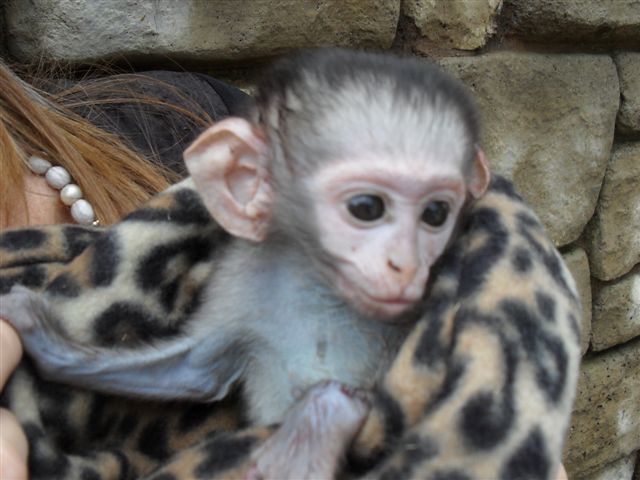
The two monkeys on the median had been moved there by Karon Hutchison who witnessed the terrible tragedy and couldn’t bear to leave the two bodies on the road surface where they would be mangled by racing wheels. It was as she was about to move the body of the adult female that she noticed the little baby miraculously still clinging to his dead mother. In disbelief she removed the totally unharmed baby from his mother’s body, took him home with her to St Winifreds and called Monkey Helpline. That’s where we met baby Kyle, named after Karon’s son who was lovingly holding and nurturing the baby when we arrived to take over the responsibility of caring for the tiny tot. (Top pic shows the proud trio of Gary, Karon and Kyle Hutchison with baby Kyle, just before handing him into the care of Monkey Helpline).

En route back to Durban we rang Jenny Morgans, Monkey Helpline’s human surrogate mother of note, and told her that a newly orphaned Vervet monkey baby was heading her way. By the time we reached Jenny she had already prepared a warm bottle, a cuddly toy and warm, soft blanket to welcome Kyle.


(Bottom pic is a close-up of baby Kyle - a few days old yet already orphaned).

With baby Kyle safely entrusted to the best care possible other than what he would have experienced with his own mother, Carol and I turned our attention to the next rescue call-out!

But if the tragedy of part 1 has left you sad and despairing, then look out for part 2, to follow shortly. I promise it will leave you smiling and with a warm feeling in your heart!

Wednesday, 22 September 2010

Correction

Apologies!!!

Gremlins even sneak into blog postings and this happened when the wrong pic found its way into the post, "Monkeys in the news - again!" Close inspection will show that the top pic in the post is not the adult male, Nico, rescued from Winklespruit, but rather a pregnant female who was also rescued in Hudd Road, Athlone Park after being attacked and badly bitten by other monkeys.

Nico will get his chance at fame in a future post!

Tuesday, 21 September 2010

Monkeys in the news - again!

What follows formed the basis of a good article that recently appeared in the "Fever" news tabloid which is distributed free of charge to residents of the upper South Coast area of KwaZulu-Natal. The article sparked a good response from readers, most of which was positive and supportive of Monkey Helpline and the monkeys :-
Yesterday was a typical day for Monkey Helpline rescuers, Steve Smit and Carol Booth, and that two of their rescue calls were from the Amanzimtoti and Winklespruit area came as no surprise.

“We have come to expect that a disproportionately high number of monkeys in this area are victims of the deliberately cruel actions of people who are intolerant of monkeys and who believe that they can injure or kill monkeys with impunity”, said Steve.

“Our first rescue yesterday in Winklespruit was a mature adult male Vervet with severe bite wounds to his lower back and neck. These could have been the result of a fight with another male monkey. However, the injuries did not appear to be the cause of the monkey’s poor state of health and we suspect that x-rays will reveal one of more lead pellets that have been deliberately shot into the monkey as he moved around his territory”.
(Top pic shows Nico, as he was named by John from Winklespruit who kept an eye on this monkey until rescuers arrived to catch him, in a transport box en route to the vet for a check up. He is recovering well from the terrible wounds that were so infected he was dying from the toxins flooding through his body. Initially the wounds did not seem to be the main cause of his poor state, but as the infected wounds healed, it became obvious that they had indeed been the cause of his debilitated state.)

Steve says that over eighty percent of all the monkeys rescued by Monkey Helpline over the past number of years have got lead pellets lodged in various parts of their body. “Many of these monkeys were in the process of dying a slow and painful death and those who could not be saved by veterinary intervention had to be humanely euthanised. Shooting animals with a pellet gun is extremely cruel, unnecessary and illegal and we will lay charges against any person identified as discharging a pellet gun in a residential area, whether or not they are actually shooting at monkeys or any other animal. Discharging or even pointing a pellet gun in a residential area or anywhere that poses a danger to another person or property is illegal in terms of specific paragraphs of Section 120 of the Firearm Control Act, At 60 of 2000. Shooting an animal with a pellet gun is also an offence in terms of the Animal Protection Act”.

The second rescue yesterday was in the Amanzimtoti area in Hudd Road, Athlone Park, and sadly was a little female monkey only eighteen months only. “She had been shot into her head, the pellet smashing through her left eyebrow and lodging in her brain. She stumbled around for hours as her brain swelled and eventually she fell off a garden wall and thrashed about on the ground until she died”. The person who called Monkey Helpline to rescue the little monkey thought she had been poisoned, but as soon as Steve and Carol arrived on the scene they noticed the pellet wound to the monkey’s head. “She suffered terrible pain and anxiety before dying”, said Steve. “She tried to keep up with her troop as it moved along but became disorientated and lost her way. A neighbour said he had seen her in his garden earlier that day and realized that something was wrong with her, but she disappeared before he could phone for help”.
(Lower pic - Fifteen-year-old Shannon Wood, the schoolgirl pro-Vervet crusader, who helps out at the Monkey Helpline "high care" every spare moment she has, goes on rescues with us and also takes care of baby and "special care" Vervets, holds the little monkey who died horribly after being shot in Hudd Road, Amanzimtoti. She also sets up and manages our education table at the Essenwood Market every Saturday. She is one awesome little lady!)

Steve appealed to people having problems with the presence of monkeys to call Monkey Helpline for advice on how to deter them humanely. “We have helped thousands of people throughout KwaZulu-Natal and elsewhere in South Africa who have had problems with the presence of monkeys, and those who say our advice does not work for them are in a minority who just don’t want to make the relatively small effort to put our suggestions into practice”.

At the time of the rescue in Hudd Road, Monkey Helpline volunteers leafleted the area with information about pellet gun cruelty and the legal consequences of discharging a pellet gun in a residential area. During this process the volunteers met a number of Athlone Park residents who were horrified about the shooting of the little monkey and undertook to report any person they saw using a pellet gun. “This was absolutely the same response we get wherever we go”, said Steve. “Only a small minority of people will deliberately resort to cruel and illegal methods to kill monkeys or chase them away from their property. With the support of law-abiding and caring people we will identify the shooters and we will have them prosecuted”.

Getting nespapers to run articles on Monkey helpline and the plight of Vervet monkeys in Southy Africa is critically important to the success of our efforts on behalf of these persecuted, maligned and misunderstood little animals. If readers of this post have any contacts in the media who they can get to write pro-monkey articles, then please get them to contact us!