Wednesday, 08 February 2012

Monkey Helpline NEEDS YOU!


Its been a while since last I sat down in front of this computer to create a new blog post, primarily because we have been so busy rescuing and caring for Vervet Monkeys, even into the early hours of the morning, that I have been too tired to get my mind around drafting a post for this blog. So what has changed to get me in front of my computer putting on screen what you now have in front of you?


Simply, Monkey Helpline is in dire straits. Financially the burden has just become too much for Carol and I to carry on our own. Actually, I depleted my personal resources a few years ago and because of the 24/7 demands of rescuing and caring for the monkeys we care so much about, I have not been able to do any work that will replenish my bank account. To do this would mean dividing my time between unrelated but paying work and doing monkey rescues, care giving and education. "Well why not do this", I hear you asking. My answer - rescues and caring for the monkeys we have rescued are, as I have already said, a 24/7 job. Unless, of course, I allocate a specific number of hours daily to rescues, care and education and also hold down a paying job so that any Monkey Helpline work that falls outside of those hours will have to, well, just wait.


Won't that just go down well with a caring member of the public who calls about a monkey run over by a car and dragging its paralysed lower body as it tries too escape into the roadside bush. "You have two options", I tell the caller. "I finish work at 4 pm, so if you could please just keep an eye on that monkey until I can get there, it will only be another three hours, I will rush over there as soon as I leave the office. Alternatively just leave the monkey and I'll pop by after work to see if its still there. If it is still there I'll pick it up and rush it to the vet, presuming its still alive."


Fact is, we can only do this work if we are available every time we are called out to a rescue, doing caring and educating in the time between rescues and the vet.


Why then is Monkey Helpline in dire straits?


In a nutshell, we have outgrown ourselves. The more effective and successful we have become at rescuing monkeys, the more monkeys we take into our care, the more time we spend at the vet, the higher our vet bills, fuel costs, cell phone bills, food bill, and other related costs. Add to this that there is virtually no currently available rehabilitation or sanctuary outlet for any of the monkeys that come into our care. More rescues really do mean more expenses, less available time and a desperate need for funding from generous and reliable sources. A sad reality of life is that without funds our capacity to rescue and educate will grind to a halt!

For a number of years now Carol has unselfishly carried the lion's share of the burden to keep Monkey Helpline delivering the rescue, care and education service for which it has become well known and highly respected. It would be folly for her to continue depleting her own resources to the point wher both she and I are destitute. This would have only one outcome and I don't need to spell that out here!


So, what now? To give up on the monkeys would destroy us emotionally, a scenario too horrible to even contemplate. Our approximately 750 rescue callouts annually would be left to other animal care organisations to deal with, and with all due respect, they wouldn't be able to successfully carry out more than a fraction of those. For the monkeys it would be a disaster and a tragedy, and for caring people who make the rescue calls it would be devastating.


But , you can help us to continue helping the monkeys. We are about to embark on a package of ambitious fundraising initiatives, included in which is an appeal for fundraisers who will initate fundraising projects for Monkey Helpline on a commission of total funds raised basis. Will all prospective fundraisers please step forward!!


Another reliable source of funds could be the recruitment of "sustainers", namely people who commit to a debit order payment of R100 monthly to Monkey Helpline. Two hundred "sustainers" would generate R20 000 per month, a healthy portion of the approximately R30 000 it costs monthly to run Monkey Helpline at its current operating level. This figure would be much higher if Monkey Helpline carried the costs of water, electricity and part time labour currently also borne by Carol, who also makes her house and garden available to Monkey Helpline's current operation at no cost.


We cannot carry on as things are right now. We have to raise the required funds and we must also expand to provide fully functional sanctuary and rehabilitation facilities. Whether or not we achieve these goals in the immediate future, and there is no alternative because as things are we have no medium or long term future, will determine if Monkey Helpline continues to exist. It has to be 24/7, 365 days a year, or nothing at all. If money is the root of all evil, it is also the food of all success. Without the necessary funding Monkey Helpline is doomed, and so are the monkeys! Monkey Helpline really does need you!!!

P.S. For all of you generous monkey-caring folk who are champing at the bit to contribute to Monkey Helpline, our banking details are as follows:


- Account name: Monkey Helpline
- Bank : Standard Bank
- Branch : Melville
- Account number: 081385439
- Branch code : 006105
- Type of account: Cheque
- Swift code: SBZAZAJJ

- Reference : Your cell phone number or email address


Pics - Top to bottom:


Top - Two baby Vervets rescued by monkey Helpline during this past "baby season" The little guy closest to surrogate mom, Jenny Morgans', is Drew. He was, as far as we know the first baby rescued in KZN this past baby season - 10 August 2010. He was found in the middle of a service road at the Bluff military base in Durban, on his own, no mother or other monkeys in sight.


Middle - This little one-year old girl was shot into the side of her head and the lead airgun pellet has lodged at the back right inside her skull, hopefully causing minimal brain damage on its way. She is currently under veterinary care and being cared for at the Monkey Helpline high care facility.


Bottom: Monkeys foraging in dustbins and refuse bags put out for collection, incur the wrath of many. Monkey Helpline educates people about how they can humanely prevent monkeys from making this kind of nuisance of themselves.




Monday, 18 July 2011

BABY MONKEY STORM WATER DRAIN RESCUE DRAMA

One thing about this business of monkey rescue is that you can be quite sure that you will constantly be challenged to do the almost impossible as a routine part of your daily rescue effort.
One such situation confronted us last Tuesday afternoon, July 12, when we responded to an impassioned plea for help from our veterinarian, Dr Kerry Easson.

Working in her Durban North garden on her day off, Kerry’s attention was drawn to a monkey’s agitated chattering beyond her front hedge. Curious, she went out into the road to see what all the fuss was about and saw an adult female Vervet monkey peering into the storm water drain in the centre of the t-junction intersection close by. Kerry went to the drain and peered through the circular, perforated cast-iron drain cover. She could hardly believe what she saw – a small baby Vervet monkey perched on the stepping rung near the top of the two-and-half meter deep manhole.

Totally flummoxed as to how the monkey had got there, Kerry did the first thing that came to mind - she called Monkey Helpline!

Carol and I jumped into our vehicle and rushed from Westville to Durban North as fast as we could considering we had to negotiate afternoon rush hour traffic made worse by faulty traffic lights and disorganized road works.

We arrived to find an agitated Kerry tapping her wrist watch at us as if to say, “what kept you?”, and a small crowd of curious onlookers and wannabe helpers. It was a relief to see Doug Fairall there. Doug is a friend and feral cat catcher supreme and together we had previously had experiences involving cats rescued from similar situations as this one we now faced with the little monkey.

One look at the tightly set, very heavy cast iron drain cover and we knew that our efforts would be wasted without the necessary heavy duty equipment which we were certain must be a normal part of the Metro water workers’ issued “tool box”.

But we decided to try and lift the lid ourselves before troubling the overworked Metro storm water standby team. Very soon we realized that we would have more success trying to lift the lid on South Africa’s arms deal corruption allegations. Desperate to get the monkey out so that we could reunite her with mommy Vervet who was anxiously waiting in a nearby tree top and keeping a protective eye on proceedings before the fading daylight forced her to follow her troop to their sleeping location, we decided to call out the relevant Metro work team. Calls to Metro water got no response other than unanswered ringing. Calls to the emergency services, however, got an immediate response and in no time a big, bright yellow Fire and Accident Emergency truck arrived with a friendly and willing emergency rescue team. Our joy was short lived when we realized that all they could offer was a bigger crow-bar than the one we had. Their best efforts were to no avail, proving the adage that "bigger isn’t always better" and so, sincerely apologetic at being unable to assist, they departed – with their crow-bar - and a promise to get hold of Metro storm water.

Regularly, as we tried to devise a plan to free the trapped monkey, we could see her small arms and hands stick up through the vents in the drain cover as if beckoning her mother to come and fetch her, and her frightened cries echoed upwards. As soon as it became dark the little monkey stopped calling for her mom and just sat hunched over in depressed acceptance of her fate. With all the banging and clanking, caused by our efforts to lift the drain cover, the little monkey never lifted her head, not even with the constant interference of torchlight being shone into the drain to see if she had moved into one of the connecting drain pipes to escape the noisy activity above her.

Hours, and many frustratingly unproductive phone calls, later we finally had the satisfaction of seeing the Metro Storm Water standby team arriving in their truck. But once again our hopes were dashed when they too offered a crow-bar as the tool of the moment. We could not believe that no special lifting device existed that would easily lift out the stubborn drain cover. So vociferously did we dismiss their offer of a crow bar that they offered to bring a “jack-hammer” to break out the entire cast iron drain top. Thanks, but no thanks! Imagine the terror in that small monkey sitting in the confines of a man hole with a jack-hammer beating the hell out of the road above.

Then sanity prevailed and the shift supervisor, now alerted to the goings on, agreed to come on site and offer the benefit of his experience. Even before arriving he authorized a crane truck to come on site and lift up the drain cover. As the crane truck arrived we knew that the little monkey would soon be safely out of that drain.

Half an hour later, it was already 7.30 pm, the crane lifted the drain cover out of the bed it had been so reluctant to leave. There had been a few frustrating moments when the steel rods, hooked into the drain cover and attached to the crane hook, bent open under strain as if made of plastic, but once these were replaced with heavy duty chains the drain cover came out with surprising ease.

And through all of this commotion the little monkey still huddled over as if by keeping her eyes closed and her back to the world above she would remain safe until her mom could rescue her in the morning. She was easily grabbed and passed into the safe and comforting arms of Carol, a full three-and-a-half hours after we first saw her frightened little face looking up at us from inside the drain. Only then did we realize how tiny she was, probably no older than six months, and covered in small cuts and healing injuries all over her little body.

For the next week or so the little monkey, named Kerry after our vet who first drew our attention to her plight, will stay in the Monkey Helpline "high care". An on-site veterinary check-up showed that she had no physical injuries from her ordeal in the storm water drain but could not discount the possibility of an ailment that might have driven her into the road water run-off drain in the first place. Once Carol is happy that Kerry monkey is healthy and ready to be released, we’ll take her back to where we rescued her and try and reintroduce her to her mother.

Kerry monkey can owe her life to alertness of vet Kerry and the combined efforts and compassion of a whole bunch of people.


What a rescue!!


Pics - Top to bottom:

1 The two-and-half meter deep storm water drain out of which the baby monkey was rescued.

2 Carol takes a hands-on approach in affixing the chains that did the trick.

3 Newly rescued Kerry monkey cuddles safely iunto Carol

4 A relieved, but proud, rescue team with Dr Kerry Easson (green theatre pants left front) and Durban Metro supervisor, Ishen Sukai (extreme right). Ishen's wife, Venesha, and young daughter, Shradda, came along to witness the operation that had called them all away from the comfort of home.

Saturday, 09 July 2011

CRUEL KZN SOUTH COAST ARROW KILLINGS CONTINUE

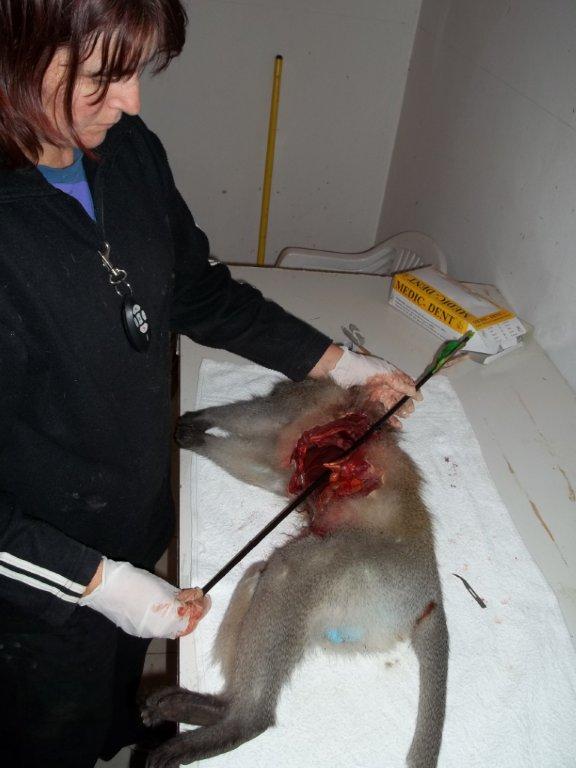
Last weekend we had the sad task of capturing a handsome young adult male Vervet monkey who was the tragic victim of some morally retarded scumbag who thought he could prove his dubious manhood by shooting an arrow into the body of an unsuspecting monkey.


One can only imagine the pain and anguish suffered by the monkey as the arrow smashed through his body then protruded obscenely from either side, sharp point at one end and gayly coloured feather flights at the other. To watch that monkey in the last hours of his life as he struggled to breath with one collapsed lung and his body shaking from the effects of massive infection, getting weaker by the minute and struggling more and more to hold tight and not fall to the ground far below, is an experience I would hope to erase from my memory but never will.


We can only hope that someone who knows who this coward is will have the courage to contact us and provide the information we need for an arrest and conviction. Nothing would give me more pleasure than to see this despicable person thrown into jail and subjected to whatever might await him there.


As of today the reward offered for information leading to an arrest and conviction has been increased to R12 000 .


Following below is a statement sent through to the South Coast Herald for inclusion in an article published this week about the shooting and subsequent death of this monkey:


"On Saturday evening we were alerted to the plight of a male Vervet monkey in Uvongo. He had been shot through with an arrow from a bow, the arrow penetrating his chest from the left next to his shoulder, and protruding from his abdomen on the right.

The monkey was high in the branches of a dead tree and rather than disturb him at the risk of losing him in the failing light, we decided to return the next morning to dart him with a sedative and catch him that way. We were told that he had been in that tree for at least two days. It was obvious from his labored breathing and the tremors racking his body every now and again that he was in a bad way.

We returned on Sunday and after some effort managed to sedate him and catch him. Unfortunately he died a few minutes after capture. Close inspection and a post mortem at the vet showed that the arrow had passed through the left lung, through the diaphragm and through his liver before exiting the right abdominal body wall.

Severe peritonitis had set in and this monkey suffered terribly before eventually dying from his injuries and the related infection.

It should be stated that this is the fifth monkey that we know to having been shot with an arrow along a sixty kilometer section of the South Coast, stretching from Scottburgh to Uvongo. (Scottburgh – 1 adult male, Pennington – 1 adult female, 1 adult male, Uvongo – 1 adult male, Oslo beach – 1 adult unknown gender).

Most South Coast residents we have spoken to are incensed at this cruelty and are quick to point out this must be the work of a few socially dysfunctional individuals. It is certainly not representative of the attitude of most South Coast residents to monkeys. Even those who consider monkeys a pest and a nuisance would not want to see them injured.

Shooting or in any other way injuring monkeys is an offence in terms of both the provincial conservation ordinance and the national Animal Protection Act, and contravention of these laws carries heavy penalties, which could include both a fine and a jail sentence.

Perceptions that monkeys are breeding out of control are totally wrong. Every troop that we monitor is actually decreasing in size from one year to the next as their habitat is degraded and they have to spend more and more time in urban areas, facing the threat of motor vehicles, dogs, electrocution on high voltage power lines, razor wire, people with pellet guns, paintball guns and catapults, poison, and much more. These cause far more fatalities than natural predators ever did.

Monkey Helpline appeals to members of the public to keep a look out for these ruthless killers of monkeys. We believe that all these cases are related, either carried out by the same person or by a small group of two or three working together. We would like to see a public comment and denouncement of these arrow killings made by the archery/bow hunting fraternity, but their silence has been deafening. This leaves the impression, expressed by many who have contacted us, that these cruel killings are condoned by the archery and bow hunting fraternities.

Anyone with information about any of these shootings can contact Monkey Helpline on 082 659 4711 (Steve) or 082 411 5444 (Carol), or on
steve@animalrightsafrica.org, on carol@animalrightsafrica.org . All information will be treated with utmost discretion and there is an R11000 reward for any information that leads to the arrest and conviction of the perpetrator or perpetrators."


Ends.


Pics:


Top - The monkey sits forlornly and in terrible pain on a Strelitzia leaf, the arrow clearly visible.


Second down - Carol holds the sedated, dying monkey upright in an attempt to assist his laboured breathing.


Third down - Checking for a heart beat - in vain.


Bottom - Our regular vet, Dr Kerry Easson, does the post mortem to assess the damage causd by the arrow.

Tuesday, 07 June 2011

To kill a monkey


There has been another monkey shot by some low-life archer on the mid-South Coast in KZN. This time its a beautiful, mature female who is still nursing a baby. Today she is dead and her baby is an orphan!

Following is the media response by Carol and myself to the above-mentioned incident:

“Appalled but not surprised”, was the response of Steve Smit and Carol Booth, joint co-ordinators of KZN-based organization, Monkey Helpline.

On Sunday afternoon Steve and Carol were called out to attempt to capture the wounded female Vervet monkey after initial attempts to capture or dart her had failed. “When we arrived at the Edward Road residence in Pennington where the monkey had taken refuge, we found her to have come to rest high in the leafy canopy of a tall tree”, said Carol. She was totally inaccessible and seemed reluctant to move. She appeared to slip in and out of consciousness and was obviously in great pain and discomfort. The bloody wound in her left side showed clearly where the arrow had penetrated her body, and the front third of the arrow could be seen protruding from her rear, and then passing right through her tail. She had chewed through the rear, flighted portion of the arrow and only the front portion of the arrow remained in her body and protruding from her rear.”

“This is the second incident of a monkey being shot with an arrow in the Pennington-Scottburgh area in the past two months”, said Steve. “In both cases the shooter hit the target but failed to score a kill. It is obvious that these sadists are not nearly the accurate archers they fancy themselves to be, and I shudder to think of what is happening out there on the hunting farms where bow-hunters are killing animals for fun and out of reach of public scrutiny.”

Steve emphasizes that both of these recent arrow-shooting incidents involving monkeys are criminal acts that can be prosecuted in terms of the Animal Protection Act, Act 72 0f 1962. “We need to identify these criminals and have them arrested and prosecuted. We believe that both perpetrators can be identified and appeal to anyone with information to contact us in this regard. Handsome rewards are offered for information leading to the arrest and conviction of one or both of the shooters.”

Carol believes that acts of cruelty such as these two arrow-shooting incidents are the work of a minority of uninformed, intolerant and downright cruel people who also believe that killing animals for entertainment is their divine right. “The fact that bow-hunting is growing in popularity is an indication that hunting is primarily a form of ego-boosting entertainment and that arguments claiming that it is an important conservation tool or a means of providing wholesome food are flawed at best and downright false at worst. Why don’t hunters just come out and say honestly that they hunt for fun and stop trying to justify their murderously bloody pastime as something honourable and necessary?”

Steve says he is amazed that there has been no public condemnation of these two arrow-shootings by any organized archery or bow-hunting body. “Their silence is deafening and I can only conclude that they have no problem with what has been done to these monkeys. One imagines that they would distance themselves from these acts of cruelty because their silence appears to condone what has happened. We have, however, been told by quite a few individual practitioners of archery that they condemn these shootings in the strongest terms. We have also been contacted by two bow hunters who say that these acts violate the ethics of bow-hunting and that they would like to see the perpetrators identified and prosecuted.”

In concluding, both Steve and Carol say that the many hours they spent watching the Pennington monkey whilst trying to lure her down to their trap, were emotionally traumatic. “We knew she was dying and we could not help her”, lamented Steve. “Her frequent cries and groans were horrible to hear but we knew that we had to stay with her, in spirit even if unable to alleviate her pain. Just before dark her baby started calling to her from the trees across the road, and we could only imagine how the emotional trauma of hearing her baby, yet knowing she did not have the strength to respond, must have tortured her mind. It certainly tortured ours and I so wished that the person who shot her could have been there to witness the terrible suffering resulting from his or her selfish and sadistic action. And he or she should have accompanied us to the vet the next morning when we picked her up at the bottom of the tree she had fallen from during the night, driven with us to the vet whilst she cried and whimpered in pain, and then watched as she died even as the vet, Dr Peter Biden, did all in his power to save her. By not witnessing the direct consequences of his or her actions, the shooter certainly got a raw deal considering all the time and money he or she invested in sourcing and procuring their weapon of cruel destruction!”

Steve and Carol stayed with the wounded monkey until a few hours after dark to ensure that she remained in the tree for the night and did not try to get back across the road into the bush where she would have died unseen. They returned to Pennington from Durban at 5am the next morning in order to be there at first light in the event that the monkey was strong enough to come down from the tree. Tragicly, she had fallen from the tree during the night and was found by residents Bill and Gay as she tried to crawl away. Bill thought she was dead and called to Carol who immediately saw that, though close to death, she was still alive. “She was hypothermic so I wrapped my warm jacket around her and kept her on my lap and legs as gently as I could whilst we raced to meet Dr Biden at his veterinary practice in Park Rynie”, said Carol. "Her cries and groans of pain were just too sad for words and I cried all the way to the vet. They were tears of both heartache and anger, both for her pain and suffering and for the fact that she had left behind a baby her so desperately needed her. That little orphan will have a tough time surviving without his or her mother!”


Top pic - The female monkey being made comfortable on Carol's lap as we leave for the vet in an effort to save her or, at the very least, end her pain and suffering.


Middle pic - Half of the arrow that killed this beautiful, nursing mother Vervet. Now she is dead, and her pain is over!


Bottom pic - Steve looks on as Dr Peter Biden of the Scottburgh Veterinary Clinic in Park Rynie does all he can to save the female Vervet's life. Sadly all in vain...


6 June 2011

Ends

Wednesday, 11 May 2011

MONKEY BUSINESS

This post is largely the article submitted to, and published in, three KZN community newspapers this past week. Its purpose is to explain the mating season behaviour currently prevalent in Vervet monkey troops, as adult males joust for position and beat off those opportunistic males who want access to females, and to emphasise that this behaviour, loud and apparently aggressive as it is, should be of no concern to humans. It is totally monkey focused:


Vervet monkey mating season is here and the result is that there is more squabbling, more fighting and lots of monkeys, particularly mature males, with severe injuries. The consequence of all of this is a huge amount of additional work for Monkey Helpline rescuers.

Steve Smit, joint co-ordinator with Carol Booth of Monkey Helpline, says that many people become very nervous of monkeys when they see the aggression and ugly injuries that are so prevalent during mating season. “But they have nothing to be concerned about”, says Steve. “All the aggression and posturing is amongst the monkeys themselves and does not translate into any aggression towards humans or their companion animals.”

Carol says that at this time of year Monkey Helpline experiences a marked increase in phone calls from concerned members of the public. “They see and hear the fighting, and also see badly injured and bleeding monkeys, and are concerned for the safety of their children and dogs, believing that they too are in danger of being attacked by an aggressive monkey. Fortunately the monkeys are only focused on the issues around mating and status within their troop and have no interest in humans or other animals.”

“We do also get lots of calls from people who are concerned about the well being of the injured monkeys”, says Steve. “ The injuries that some of the monkeys sustain can be extremely bad and to the untrained eye they look life threatening, which they often are. Interestingly enough, most people think that these monkeys have been shot or bitten by a dog. But monkey-inflicted injuries are easily recognized because their razor sharp teeth inflict injuries that resemble a scalpel cut. Once inflicted the injury often gapes and looks very bad. Our dilemma is deciding which calls we respond to and which we don’t. We can’t possibly go out and rescue every monkey who gets injured during these confrontations. We don’t have the capacity to do this, but it is also not always necessary. Monkeys have amazing healing capacity and recover from the most unbelievable injuries. However, we also know that an injury that looks minor can result in an infection, even tetanus, and cause the death of the monkey. It is never an easy decision to make but it is something we do every day. When someone phones in out of concern for a monkey, we have a series of pertinent questions we ask. Based on what we are told we then decide whether to go and carry out the rescue or not. If there is any doubt we will always go out to see for ourselves and then make the decision whether or not we’ll catch and treat the monkey.”

Carol believes that the mating season aggression between urban monkeys is far greater than amongst monkeys living in more natural areas. “Urban monkeys are under ongoing stress because of constant harassment. People don’t realize that monkeys are not invading our living space. Wherever we see them in our suburbs it is because they are in their traditional territory that has been drastically changed by human occupation and development. They have been here for many generations and have been subjected to increasing persecution, both deliberate and unintentional. Destruction of natural habitat, being chased and attacked by dogs, being shot at and chased from one property to the next by homeowners, having to cross dangerous roads, encountering razor wire and electric fencing, and much more has left urban Vervet monkeys on edge, and as a result of this the fights that take place between monkeys are more intense and frequent than would be the case if they were less stressed and had fewer dangers to deal with. Domestic dogs are predators and kill far more monkeys in urban areas than are killed by natural predators in the wild. In urban areas, as monkeys go about their daily foraging, they encounter a lethal predator in the form of a domestic dog virtually every fifteen to twenty meters. Their mortality rate is much higher than would be the case if they were living in a more natural environment, which is why urban troops of monkeys are much smaller than troops in the wild, and are in fact steadily decreasing in size from one year to the next.”

Steve and Carol are heartened by the fact that most people wish the monkeys no harm, and once their fears about monkeys have been allayed they become far more tolerant of the presence of these little animals. “Very few people actually wish monkeys any harm, and even fewer still will deliberately harm them”, says Carol. “We offer free advice to anyone who is having problems with monkeys around their home or at schools, etc, and we do many educational talks throughout the year. Monkeys are amazing animals and it takes just a little time and effort to ensure that they are not an intolerable nuisance. What monkeys need more than anything else is your understanding of who they are, why they behave the way they do, and what you should and shouldn't do when they are around.”

Both Steve and Carol ask that members of the public understand that they are full-time volunteers doing this work out of love for monkeys and also to help people who are experiencing "problems" with the presence of monkeys.


“We get many calls every day for assistance and advice, or from people reporting an injured monkey, so we have to prioritize what we will deal with first”, says Carol. “Obviously someone needing advice or assistance is rarely, if ever, more important than a rescue, so if we must decide what to attend to first, the rescue wins hands down, and then we get to the advice or assistance as soon as we are able to after the rescue. Unfortunately it is not uncommon for callers to threaten to shoot or poison the monkeys if we don’t respond immediately in the way they expect. These callers get told in no uncertain terms what will happen to them if they do act on their threats. We also have to put up with verbal abuse and even threats of violence from people who believe that we are responsible for their problems with monkeys or because we don’t drop everything in order to give them our undivided attention. Many people erroneously believe that we are paid by the authorities to do this work and so expect us to provide an immediate service that is paid for by their taxes. Other than our personal funding of the Monkey Helpline, our only financial support comes in the form of small, random donations from the public.”


Pics top to bottom:


Top - A brave adult male Vervet monkey threatens Monkey Helpline rescuers as they pick up a twelve week old baby Vervet lying next to the road in Havenside, Chatsworth after being hit by a speeding car. He was supported by the mother Vervet and most of the troop members. When the healthy baby was returned to her mother at the same location two weeks later, this male was equally protective. On both occasions Carol was able to keep the entire troop of monkeys at bay simply by shaking and flicking a towel at them.


Middle - This adult male Vervet monkey spent eight months with Monkey Helpline recovering after the amputation of his left leg - carried out by veterinarian, Dr Kerry Easson - after a bad injury to his foot led to severe infection in much of the bone in that leg. He was released in Cowies Hill at the same place he was originally rescued, but three weeks later he was back on the very exercise cage in our garden where he had spent months regaining his strength and agility. He has become a fully integrated member of our free ranging wild troop and visits our home with them almost every day. He shows no resentment towards us for the months of incarceration, medication and injections we forced on him.


Bottom - Monkeys visiting our garden enjoy snacks in the company of a hen and an Egyptian goose. They are frequently joined by a number of our rescued cats who enjoy the brown bread we mix with the snacks given to the monkeys. Not once has there been any aggressive behaviour by the monkeys towards the birds or the cats!


Tuesday, 03 May 2011

Don't judge a book by it's cover

As I write these posts I am always mindful of the need to present as much of the positive as is possible in a situation that is really dire as far as Vervet monkeys are concerned. Believe me, this is not an easy task, but in order to retain one’s sanity and be able to find the strength to get up each morning and face the tragedy that you know will hit you right between the eyes and without warning, you cling to the positives and use them as beacons of light as you navigate through the ever present darkness of pain and death that characterizes Vervet monkey rescue and care.


At Monkey Helpline we deal with over seven hundred rescue call-outs every year. As each rescue drama unfolds it is indelibly imprinted in your mind, and such is the effect on subconscious memory that hardly a night passes without a dramatic dream about Vervets. Hardly ever are these dreams pleasant!


And yet, as alluded to earlier, there are positives. I suppose the most pleasantly surprising positive, yet least dramatic, is finding out every day how many people actually love and care for Vervets, or are intrigued and fascinated by them. Everywhere we go we meet these people and they far outnumber the “I hate those invasive, dirty creatures”-brigade. Which is why Monkey Helpline has started on a membership drive calling on all fair-minded, caring and compassionate people to show visible support for the monkeys by becoming a member of Monkey Helpline (there is no membership or joining fee) or any other monkey-care organization. (See recent blog post – “Vervets need your help” - for details on how to become a member)


Now I have to share this with you. Often as we drive around doing a rescue, looking for a monkey, leafleting an area where there are suspected shooters or people are having so-called “monkey problems”, we see people in their cars or gardens who look for all the world as if they could be the shooter or monkey-hater. Just something about their face or demeanor! Well, as you have read in the most recent post prior to this one, a monkey was shot with a bow and arrow by some moral retard in Scottburgh South. In our efforts to locate and trap the injured monkey, we met Adri and Koos in whose garden the troop of monkeys containing the arrow-shot monkey spend time very day. So obviously we knew this would be an ideal place for our trap.


It was an absolute education spending that first afternoon with these two wonderful people in the hope that we would manage to trap Tweeter, as this monkey was known to them. There was this middle-aged couple surrounded by thirty-plus monkeys of all ages and genders, sharing out treats amongst the monkeys and interacting with each one individually as if he or she were a loved member of the family. Adri and Koos called each monkey by name, respected each one’s unique personality and knew who was who’s mother, child or sibling. And so much more!


But Adri and Koos are not unique. We meet good folk like them frequently. But what was unique was seeing Koos amongst the monkeys. Unique because if I had driven past Koos standing in his garden or in front of his house on the verge, I would definitely have made the assumption that here was undoubtedly, at best, a monkey hater or, at worst, a monkey shooter. Why? Well, if you met Koos you would understand why at first glance I would guess that Koos, a retired police dog handler, was a shooter and not a lover of monkeys. Which once again proves that appearances can be deceiving! Very deceiving! Far from hating monkeys, Koos loves them and I had this huge grin inside of me as I listened to Koos telling me how people need to catch a wake up and respect the fact that Vervets occupied the suburbs we now claim as our own, long before the first house or road was built there. Similar sentiments voiced by Adri served to confirm that for as long as these two Vervet monkey guardians reside in Scottburgh South, the monkey haters need to tread carefully. Hearing Koos talk to the monkeys in lyrical and loving tones, calling “his babies” by endearingly affectionate names, is really something special, and I shudder to think what side of Koos the shooter of Tweeter might experience if Koos gets to him before the police do!


So, if you ever happen to be in Scottburgh South, and you see a large, proudly moustached man with a troop of Vervets in close attendance, look and listen carefully, and you too will leave with a big grin inside of you and you will draw comfort from knowing that as long as he is there, that troop of Vervets is about as safe as a troop can be in a suburb that is also the home of at least one sick person who believes it is okay to shoot an arrow through a monkey’s body in a sadistic attempt to kill it!


Pics:


Top pic - Female Vervet monkey, Mommy One-eye, with her most recent baby happily and safely enjoying a snack provided by Adri and Koos.


Bottom pic - Tweeter before the arrow was unexpectedly pulled from his body. Latest news from Adri and Koos today, 3 May, is that Tweeter still vists every day and is looking strong and healthy despite his brush with death.

Monday, 02 May 2011

Monkey shot with bow and arrow in Scottburgh South

This post starts with a letter sent to, and published in, the Mid-South Coast Mail on 13 April this year. The letter follows:


Dear Editor,


This is an urgent plea from Monkey Helpline to residents of Scottburgh South for assistance in
locating a critically injured adult male Vervet monkey.

Today, April 11, we were called to Ann Arbour Road where a resident had the horrifying experience of seeing this male monkey with a red and yellow, flighted arrow protruding from both sides of the body. The monkey was trying to drink water from her swimming pool. By the time we arrived in Scottburgh from Westville the monkey had moved off. After searching for a
while we sighted the monkey lying over a branch in a tree across the road.

In obvious pain the monkey would not respond to our attempts to lure him down to our trap and we had to think of other ways to capture him. At that point the only method of capture that might have been successful was through the use of a tranquilizing dart.

It took us over two and a half hours to locate a vet capable of darting the monkey and willing to assist us. Unfortunately just as the vet was preparing to fire the dart, the monkey, who hadn't moved for over two hours, looked down, saw what was about to happen and fled through the trees. An exhaustive search for the monkey proved fruitless.

We appeal to anyone who sees this monkey to please call us on 0826594711 or 0824115444. We also appeal to anyone who might know the person who shot the monkey or is aware of a neighbor using a bow and arrow in that area to share this information with us.

A last word for the shooter; "If we do not catch this monkey soon, he will die a slow and agonizing death. So when you go to bed tonight imagine how you would feel if you were lying there with a spear stuck through your body, with no pain relief, no antibiotics, hungry, thirsty and unable to sleep because of the unrelenting pain wracking your body. You are undoubtedly a cruel and sadistic coward and we will find you and you will be prosecuted ! ".


Ends.


Update: Last weekend Tweeter, amazingly still alive and seemingly healthy, arrow protruding grotesquely through his body, entered a Monkey Helpline trap left at a home where he was loved, fed and relaxed. Unfortunately he managed to avoid being trapped but as he backed out of the trap the arrow got stuck in the side wire and pulled out of his body. The arrow remained in the trap but Tweeter is running free. He has been seen almost every day and still seems in good health. Expert veterinary opinion is that the arrow must have missed all vital organs and blood vessels and that there is a good chance that Tweeter will survive without veterinary intervention.


Today, 2 May, Monkey Helpline submitted the following article for publication in this week's Mid-South Coast Mail:


Reward offered

A reward has been offered for information leading to the arrest and successful prosecution of the person or persons involved in the recent bow and arrow shooting of Tweeter, the Scottburgh South male Vervet monkey.

Monkey Helpline spokesperson, Steve Smit, says his organisation is offering a R1000 reward for any information that will enable the organization to seek justice for Tweeter and all the other monkeys who are constantly the victims of human acts of violence. “We are an NGO and entirely volunteer driven so do not have the resources to offer a larger reward. However, we believe that someone out their knows who shot Tweeter and is just waiting for the right moment or incentive to share that information with us so that charges can be laid in terms of the Animal Protection Act. Anyone wanting to increase the incentive by adding to the reward can contact this newspaper. The many Scottburgh South residents who know Tweeter for his gentle and relaxed demeanor are incensed by this senseless act of violence against him. Like us, they want to see the perpetrator arrested and charged ”.

Steve says that although the incidence of monkeys being shot at with pellet guns, catapults, paintball guns and bows results in a high number of injuries and death, the people doing this are relatively few in number. “Unfortunately, it takes only one heartless person or irresponsible child in your street, complex or neighbourhood to shoot at monkeys every time they are able to and the results are disastrous for the monkeys. The consequences are pain and tremendous suffering, and often a lingering death over weeks. Over eighty percent of all monkeys rescued by Monkey Helpline have got lead pellets in their bodies, a terrible statistic considering we do over seven hundred rescues every year”.

And the shooting of Tweeter with a bow and arrow was not an isolated incident. According to Steve he has been told of a number of monkeys found with arrows through their bodies, and has had personal experience of quite a few of them over the years. “Recently we trapped a male Vervet in Waterfall near Hillcrest with an arrow through his arm. The arrow smashed the bone just above the elbow joint and only excellent work by our vet, Dr Kerry Easson, saved his arm. The monkey was successfully released back to his troop two months later. We have even rescued a Hadeda with an arrow right through his body, and last year we found an arrow on our lawn next to our monkey exercise cages”.

“On another occasion, after we had completed an educational talk about monkeys at a primary school, we were approached by a pupil who tearfully told us that her dad had recently shot two monkeys in their Kloof garden with his bow and arrow. She said her dad had put down food on the lawn for the monkeys and whilst they were huddled around the food eating it, he shot at them. She said the arrow went through two of the monkeys and they both died. He just put them in a black bag and left them outside for the refuse collection. I asked if the monkeys were a problem to her family and she said they all loved the monkeys so she doesn’t know why her dad shot them”.

Steve appealed to people who are troubled by the presence of monkeys not to harm them, but rather to get in touch with Monkey Helpline for advice and assistance. “At worst monkeys can be a nuisance, but they are not dangerous and only very rarely, after extreme provocation have they been known to bite in self-defence. So, unless you literally grab hold of a monkey, or your dog catches and bites a monkey, you or your dog are not in any danger of being bitten”.


Monkey Helpline offers free advice on how to deal humanely with an unwanted monkey presence. “There is no reason to ever hurt a monkey”, says Steve. “And once we explain why monkeys are here, that there is no monkey overpopulation, that monkeys don’t attack and bite people or pets, that here has never been a recorded case of rabies in a Vervet monkey in South Africa and that monkeys are a very important part of our natural environment, most people have a better understanding of, and attitude towards, them. All it takes is a bit of tolerance and understanding. The monkeys were here long before we were, and they have nowhere else to go”!


Pics top down:


Top pic: Tweeter photographed a week after he was shot with the arrow, and a week before the arrow got stuck in the trap and pulled out of his body.


Middle pic: The trap with the arrow still in it after Tweeter managed to avoid getting caught.


Bottom pic: This stunning adult male Vervet shot though his arm by an unknown person in Waterfall near Hillcrest. The pic shows him under sedation at the veterinary clinic prior to removal of the arrow and pinning of the smashed bone.