Tuesday, 16 November 2010

Happiness!

In the previous blog posting I told you about baby Kyle and how he ended up in the care of Monkey Helpline surrogate mom, Jenny Morgans. It was a sad tale of death and orphaning. Now I can share with you an experience that will bring tears of joy and leave you elated knowing that tragedy can have a happy ending.

But first I must take you back about six weeks prior to the rescue of baby Kyle - (Top pic shows a crying, blood-smeared Kyle newly rescued off his dead mother's body).

Monkey Helpline was called out to Hudd Road, Athlone Park in Amanzimtoti by Grant Thomson, who had spotted a pregnant female Vervet in his garden with a really bad injury to her left arm. A lover of the Vervet Monkeys, Grant had watched this female as she struggled to compete for food and appeared totally out of sorts because of the severity of her injury, and he felt that we might be able to help her. As soon as we saw her we decided that we needed to trap her and get her to our vet, Dr Kerry Easson of Riverside Veterinary Clinic in Durban North, for a check up and treatment of her injury.

We trapped her and rushed her straight to Kerry who, after sedating her, diagnosed a severe and badly infected bite wound to that region of her left arm above and below the elbow, and cutting right through the muscle and main tendon at the back of her arm just above and through the elbow. Kerry re-attached muscle and tendon and Leila, as Carol had named her, came to the Monkey Helpline High Care to recover.

Three weeks later Kerry checked her almost fully healed injury and declared her fit for release. Our attempts over a number of weeks to reintroduce Leila to her troop failed. The first time we tried to return her to her troop almost ended in disaster. Shortly after we released her, a group of adult females viciously attacked her, chasing her into a house where we managed to recapture her, and during both subsequent attempted releases they were so aggressive towards her whilst she was still confined in our transport cage that we decided it would be too risky to release her in her advanced state of pregnancy. We felt that in her best interests and those of her as yet unborn baby we should now place Leila in a rehabilitation programme.

Unfortunately, two weeks later Leila had a miscarriage, giving birth to a dead but fully formed, close to term, baby!

Now back to baby Kyle!

After taking Kyle into her care, Jenny took him to vet Kerry where a thorough check-up confirmed that he had miraculously survived the violent death of his mother without so much as a scratch or bruise, and that all the blood Jenny had cleaned off him was in fact his mother’s.

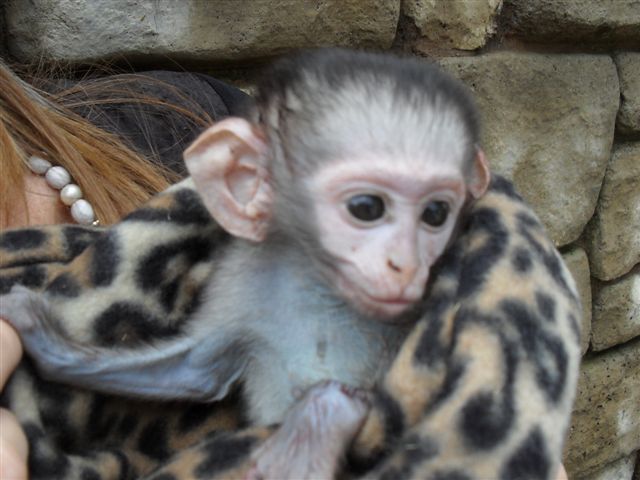
Back home, Jenny wrapped Kyle in a blue blanket, bottle-fed him, then carried him with her to check on the monkeys in her outside recovery cage. As Jenny approached the cage, Leila immediately came right up to her and gazed intensely at the blanket. Jenny opened the blanket so that Leila could see Kyle. To Jenny’s amazement Leila reached through the wire and gently touched Kyle. She clearly wanted to take the baby. Jenny phoned us right away, so we raced over to her house to see if Leila would actually take Kyle from Jenny and adopt him as her own.

With Carol trying to video-film the whole thing, Jenny entered Leila’s cage with Kyle. Leila rushed forward, grabbed Kyle from Jenny, tucked him into her body and ran back to her sleeping basket. We held our collective breath as she inspected Kyle and left us in no doubt that she had adopted him the moment she laid eyes on him.

Kyle, though, was not that easily convinced that this was his new mother. He squirmed and twisted and climbed and cried right through the remainder of that day and the next. He was a baby from hell, but Leila did not flinch. She gently pulled him back every time he tried to escape her hold, pushed his face firmly against her nipples encouraging him to suckle, all the time making sure he was safely within the circle of her arms. In his frustration to “escape” to his own mother who, no doubt he still believed was somewhere out there waiting to “rescue” him, he bit and scratched and pulled at any part of Leila’s body he could reach. Her gentle and loving resolve was just awesome to behold and she tolerated everything he could throw at her, holding him tight and kissing him on top of his little head and over his face in an effort to console and comfort him.

Of course Leila had not actually had a baby and it was exactly seven days since her miscarriage, so she had no milk in her breasts. And Kyle was getting hungry, and also grinchy, and he needed food! So we had no choice but to catch Leila and steal Kyle back from her. Jenny kept him with her long enough to give him two good bottle feeds and then gave him back to Leila who grabbed him from Jenny the moment she opened the inner door of the cage. Kyle, his little tummy full of warm milk, spent a comfortable night sleeping tightly clutched to Leila’s comforting body. Throughout the next day, which happened to be Friday, Leila loved and nurtured Kyle whilst he put on his very best brat kid performance. She, on the other hand, was being the best mother any little kid monkey could ever wish for – though he did not yet appreciate his blessing! He did however latch to his adoptive mom’s nipples – both nipples in his mouth at the same time as is the way with Vervet babies – but she still had no milk and this must have contributed greatly to his unhappiness. So once again, at the end of the day, we had the unenviable task of catching Leila and taking Kyle away to be bottle-fed. And once again Laila was waiting at the door to grab Kyle back from Jenny after he had drunk his fill from the bottle.

I must mention that throughout this entire process we were constantly in touch with our good friend, Karen Trendler, one of South Africa’s foremost wildlife care-givers and rehabilitation experts, who is also Monkey Helpline’s rehabilitation and wildlife husbandry advisor. Karen’s calm support and advice were invaluable!

Come Saturday morning and Kyle seemed very content as he suckled from his new mom - (in contrast the centre pic shows a sad, newly orphaned baby Kyle with his rescuer, Karon Hutchison, her husband, Gary, and son, Kyle), and Leila was going about her business unfazed, one protective arm always holding Kyle close and safe. But by that evening Jenny was like a mother hen with a newly hatched brood of chicks who were all running in different directions. She was convinced that Kyle was getting weaker, that he was dehydrated and that we must come and get him for her to bottle-feed again. You see, Jenny is used to being the surrogate mom, where she can feed and feel and touch and love the baby monkey - she is lovingly in control, just like any good mother should be! It was really hard for her to watch baby Kyle from a distance and not know if his tummy had food in it or not! So Carol and I went over and had a good look at Kyle. He seemed fine to us. But, just to be sure, I phoned Karen and discussed with her what I was seeing. She asked the right questions, got the answers and suggested we leave Kyle till the morning and see how he was doing. She reckoned that if he wasn’t acting all irritable, was latched to the nipples, looked bright-eyed and was firmly attached to his new mom, he was probably fine and that in all likelihood Leila was starting to produce milk.

By Sunday morning Kyle was still suckling, wasn’t crying and looked pretty strong. And we haven’t touched him again. He is the happiest, healthiest baby monkey you could ever meet. Leila has milk to spare and is the most awesome mom. She absolutely loves her baby!

So how did this all come together so beautifully after the terrible tragedies that befell Leila and Kyle?

When Leila gave birth to her dead baby, she carried the tiny body for two days. We decided not to take the baby away until she allowed Jenny to do so. When she did put the body down, Jenny went in, picked it up and wrapped it in a blue blanket. Outside the closed inner gate, Jenny put the little bundle on the ground then opened it enough for Leila to see her dead baby. Jenny left it like that for a while then wrapped the baby and took the bundle away. When, five days after taking Leila’s dead baby away in a blue blanket, Jenny showed baby Kyle to Leila and got the response she did, she had by complete coincidence also wrapped Kyle in a blue blanket. Only afterwards when we discussed Leila’s first reaction to Kyle did the importance of the blue blanket strike us. Jenny suddenly recalled that Leila had last seen her dead baby taken away in a blue blanket, and now when Jenny opened a blue blanket again there was “her” baby, alive! Some might scoff at this but we really do think that Leila might believe that Kyle really is her baby. After all, we have rescued little monkeys hit by motor cars or bitten by dogs and left for dead. We have treated them and successfully reunited them with their mothers, three, four, and even up to ten weeks later. The mother has recognized her child and taken it back and the experience is something that we cannot find the words to adequately describe – it is simply mind-blowing!

Now the future looks bright for mom and baby. They will form part of a seed troop that is bonded together as part of a process of bonding a larger number of rescued monkeys into a full size troop that will, in a few years time, be rehabilitated into the wild where they will live as all releasable monkeys should – FREE!!!

Sunday, 07 November 2010

What an eventful past few weeks. I could write three blog postings every day in an effort to keep you abreast of everything we have experienced and witnessed. There has been heartache and elation, incredulity, anger, confirmation in our belief that most people are genetically programmed to be caring and compassionate, and even laughter.

In this blog posting I’ll share with you “part 1” of an experience that grows from the depths of desperate heartache to the unexpected pinnacle of elation.

Heartache as we gathered up the broken bodies of five Vervet monkeys killed south of Durban on the N2 in one tragic incident – three on the southbound lanes and two on the edge of the median adjacent to the north bound lanes. Two adult females, their two-year old daughters and an about-to-be-born baby, all killed by motor vehicles, with the unborn baby literally smashed from her mother’s broken body. And as we darted across a busy freeway collecting the bodies, two newly orphaned young Vervet monkeys sat in a nearby tree calling pathetically for mothers and siblings whose answering calls and loving caress they would never hear or feel again.

There will no doubt be criticism of our risk-taking on a busy freeway to collect the bodies of already dead monkeys, but unfortunately, leaving them on or near the road often results in further tragedy as related monkeys, especially the youngsters or mothers of those killed, run back onto the road confused as to why the dead or injured monkeys are not moving or following. Furthermore, dead animals left in the road often lead to the death of other animals, such as raptors and mongooses, even domestic dogs and cats, who attempt to feed off the freshly killed animal.

The two monkeys on the median had been moved there by Karon Hutchison who witnessed the terrible tragedy and couldn’t bear to leave the two bodies on the road surface where they would be mangled by racing wheels. It was as she was about to move the body of the adult female that she noticed the little baby miraculously still clinging to his dead mother. In disbelief she removed the totally unharmed baby from his mother’s body, took him home with her to St Winifreds and called Monkey Helpline. That’s where we met baby Kyle, named after Karon’s son who was lovingly holding and nurturing the baby when we arrived to take over the responsibility of caring for the tiny tot. (Top pic shows the proud trio of Gary, Karon and Kyle Hutchison with baby Kyle, just before handing him into the care of Monkey Helpline).

En route back to Durban we rang Jenny Morgans, Monkey Helpline’s human surrogate mother of note, and told her that a newly orphaned Vervet monkey baby was heading her way. By the time we reached Jenny she had already prepared a warm bottle, a cuddly toy and warm, soft blanket to welcome Kyle.


(Bottom pic is a close-up of baby Kyle - a few days old yet already orphaned).

With baby Kyle safely entrusted to the best care possible other than what he would have experienced with his own mother, Carol and I turned our attention to the next rescue call-out!

But if the tragedy of part 1 has left you sad and despairing, then look out for part 2, to follow shortly. I promise it will leave you smiling and with a warm feeling in your heart!

Wednesday, 22 September 2010

Correction

Apologies!!!

Gremlins even sneak into blog postings and this happened when the wrong pic found its way into the post, "Monkeys in the news - again!" Close inspection will show that the top pic in the post is not the adult male, Nico, rescued from Winklespruit, but rather a pregnant female who was also rescued in Hudd Road, Athlone Park after being attacked and badly bitten by other monkeys.

Nico will get his chance at fame in a future post!

Tuesday, 21 September 2010

Monkeys in the news - again!

What follows formed the basis of a good article that recently appeared in the "Fever" news tabloid which is distributed free of charge to residents of the upper South Coast area of KwaZulu-Natal. The article sparked a good response from readers, most of which was positive and supportive of Monkey Helpline and the monkeys :-
Yesterday was a typical day for Monkey Helpline rescuers, Steve Smit and Carol Booth, and that two of their rescue calls were from the Amanzimtoti and Winklespruit area came as no surprise.

“We have come to expect that a disproportionately high number of monkeys in this area are victims of the deliberately cruel actions of people who are intolerant of monkeys and who believe that they can injure or kill monkeys with impunity”, said Steve.

“Our first rescue yesterday in Winklespruit was a mature adult male Vervet with severe bite wounds to his lower back and neck. These could have been the result of a fight with another male monkey. However, the injuries did not appear to be the cause of the monkey’s poor state of health and we suspect that x-rays will reveal one of more lead pellets that have been deliberately shot into the monkey as he moved around his territory”.
(Top pic shows Nico, as he was named by John from Winklespruit who kept an eye on this monkey until rescuers arrived to catch him, in a transport box en route to the vet for a check up. He is recovering well from the terrible wounds that were so infected he was dying from the toxins flooding through his body. Initially the wounds did not seem to be the main cause of his poor state, but as the infected wounds healed, it became obvious that they had indeed been the cause of his debilitated state.)

Steve says that over eighty percent of all the monkeys rescued by Monkey Helpline over the past number of years have got lead pellets lodged in various parts of their body. “Many of these monkeys were in the process of dying a slow and painful death and those who could not be saved by veterinary intervention had to be humanely euthanised. Shooting animals with a pellet gun is extremely cruel, unnecessary and illegal and we will lay charges against any person identified as discharging a pellet gun in a residential area, whether or not they are actually shooting at monkeys or any other animal. Discharging or even pointing a pellet gun in a residential area or anywhere that poses a danger to another person or property is illegal in terms of specific paragraphs of Section 120 of the Firearm Control Act, At 60 of 2000. Shooting an animal with a pellet gun is also an offence in terms of the Animal Protection Act”.

The second rescue yesterday was in the Amanzimtoti area in Hudd Road, Athlone Park, and sadly was a little female monkey only eighteen months only. “She had been shot into her head, the pellet smashing through her left eyebrow and lodging in her brain. She stumbled around for hours as her brain swelled and eventually she fell off a garden wall and thrashed about on the ground until she died”. The person who called Monkey Helpline to rescue the little monkey thought she had been poisoned, but as soon as Steve and Carol arrived on the scene they noticed the pellet wound to the monkey’s head. “She suffered terrible pain and anxiety before dying”, said Steve. “She tried to keep up with her troop as it moved along but became disorientated and lost her way. A neighbour said he had seen her in his garden earlier that day and realized that something was wrong with her, but she disappeared before he could phone for help”.
(Lower pic - Fifteen-year-old Shannon Wood, the schoolgirl pro-Vervet crusader, who helps out at the Monkey Helpline "high care" every spare moment she has, goes on rescues with us and also takes care of baby and "special care" Vervets, holds the little monkey who died horribly after being shot in Hudd Road, Amanzimtoti. She also sets up and manages our education table at the Essenwood Market every Saturday. She is one awesome little lady!)

Steve appealed to people having problems with the presence of monkeys to call Monkey Helpline for advice on how to deter them humanely. “We have helped thousands of people throughout KwaZulu-Natal and elsewhere in South Africa who have had problems with the presence of monkeys, and those who say our advice does not work for them are in a minority who just don’t want to make the relatively small effort to put our suggestions into practice”.

At the time of the rescue in Hudd Road, Monkey Helpline volunteers leafleted the area with information about pellet gun cruelty and the legal consequences of discharging a pellet gun in a residential area. During this process the volunteers met a number of Athlone Park residents who were horrified about the shooting of the little monkey and undertook to report any person they saw using a pellet gun. “This was absolutely the same response we get wherever we go”, said Steve. “Only a small minority of people will deliberately resort to cruel and illegal methods to kill monkeys or chase them away from their property. With the support of law-abiding and caring people we will identify the shooters and we will have them prosecuted”.

Getting nespapers to run articles on Monkey helpline and the plight of Vervet monkeys in Southy Africa is critically important to the success of our efforts on behalf of these persecuted, maligned and misunderstood little animals. If readers of this post have any contacts in the media who they can get to write pro-monkey articles, then please get them to contact us!

Sunday, 19 September 2010

YOU CAN HELP US HELP MONKEYS


“I own a thatched property in Marina Beach, lower south coast. My roof is being systematically destroyed by a troop(s) of monkeys. When I contacted my insurance broker about a claim to effect repairs, he told me that monkeys are classed as vermin, so I would not be able to claim for the damage/repairs. Is this the case?If monkeys are vermin, is it legal to poison them like rats & mice? I understand the need for conservation of nature in the area. However I can't afford the bills to continually repair my thatch”.

Above is an extract from a letter I received this past week, and it so clearly illustrates the stupidity that informs the thinking of a small but dangerous number of morally retarded cretins whose actions are having a terrible impact on the lives of many monkeys throughout KwaZulu-Natal and other parts of South Africa. What kind of twisted mind are we dealing with, who even considers poisoning as an acceptable means of resolving his problems with monkeys?

Certainly in KZN monkeys are not classified as vermin and it is most definitely illegal to “poison them like rats and mice”! Fact is that monkeys are protected nationally by the Animal Protection Act and provincially by the KZN Nature Conservation Ordinance. They are also protected by the efforts of organizations like Monkey Helpline, various animal protection groups, and by a not insignificant body of ordinary people who feel very strongly about the welfare of monkeys and other animals.

Which brings me to the point of this blog post, namely, to show that without the support of the animal-caring public, Monkey Helpline cannot carry out its mandate to educate, rescue, provide veterinary care, post-veterinary care, rehabilitate, release or provide life-long sanctuary.

Yes, without this support Monkey Helpline would not even have known about most of the three-hundred and twenty-seven rescue callouts we responded to between January 1 and June 30 this year. These calls originated from across the age, race and gender spectrum, from people representing all sectors of our society, but all of them with three things in common – decency, integrity and compassion!

And if this seems like a high number of monkeys in need of our help, believe us when we tell you that it represents only a fraction of the total number of monkeys suffering and dying in places where no caring person gets to see them and do something to help. If Monkey Helpline rescue figures are extrapolated to the total area traversed by troops of monkeys throughout KwaZulu-Natal every day, then a staggering number of monkeys are being injured or killed here every year. Judging by the non-scientific observations by Monkey Helpline rescuers of the situation as it affects urban Vervet monkeys, it is not unrealistic to fear the extinction of these little animals within the lifetime of our current generation.
(The pics exhibited in this posting show just how deranged a person can be. Top pic shows a beautiful adult male Vervet with an arrow shot from a bow through his arm. Next pic shows the x-ray of his humerus shattered by the arrow just above the elbow joint. Bottom pic of this monkey after the broken arrow was removed from his arm, with veterinarian, Dr Kerry Easson holding the three pieces of arrow.)

If you want to make a real difference for monkeys in South Africa, you cannot do better than to show your support for our efforts to help them. We know from our day to day experiences, and the people we meet and talk to, that there are far more people who care about the welfare of monkeys than there are people who dislike and loathe monkeys to the extent of harming or killing them. Unfortunately the pro-monkey people are not as vociferous about their feelings as are the anti-monkey people. We need to let these anti-monkey cretins know that they are a small minority whose aggression and violence towards monkeys will not be allowed to go unchallenged.

So, how do YOU show the monkeys that you are batting for them?

Its pretty simple. Arrange with your kids' school for Monkey Helpline to come and do a Power Point-supported talk to pupils and teachers. Volunteer to work at the Monkey Helpline “high care” and recovery facility. Distribute Monkey helpline leaflets. Become a "monkey monitor”. Help us at our Essenwood Market table on Saturdays between 8.30am and 2pm – an hour or two whenever you can, would be a great help. Become a Monkey helpline member, donor or sustainer. This and so much more – contact Steve or Carol on 082 659 4711 or 082 411 5444 respectively or email us at steve@animalrightsafrica.org .
Remember, without your help and support we cannot continue helping monkeys in distress. THE MONKEYS NEED YOU!!!

Friday, 27 August 2010

Ever so "Flippin' Cute"

Monkey Helpline blog readers will recall the little Vervet monkey that Carol was holding close in the blog posting of 16 August, “Monkeys still in harm’s way”. Since named “Flippin’ Cute”, because he is such an amazingly affable and bright little chap who holds no grudges against humans in spite of the despicable and cowardly way he has was attacked by some pellet gun-wielding low-life, he has made an amazing recovery.

In addition to being shot three times into his small body, of which at least one pellet went into his chest, he also sustained a badly fractured skull, probably after falling out of a tree or off a roof when he was shot (top pic shows just how swollen Flippin' Cute's eyes were after the trauma to his head).

Now both eyes are completely open and he has perfect vision (centre pic). There does not, at this stage appear to be any brain damage in spite of the severe concussion he suffered. He has an amazing appetite and already I am trying to convince Carol that he is a tad plump! And he is ever so cute!!

Evenings, whilst Carol is doing admin work he sits next to her on the table with a bowl of mixed food and chomps away to his heart’s content. And he watches TV with a real interest (bottom pic), responding to various things he sees, especially the animals on Animal Planet. He was terrified by a big dog even before it barked, watched curiously as a cat was treated by a vet, and then jumped into Carol’s arms and hid his face in her jersey when a turkey gobbled.

He is uncharacteristically afraid of other small monkeys and so he is being introduced slowly to two other monks of about the same age. It is important that he keeps in touch with his monkey-hood because we will make every effort to reunite him with his troop and his mother. If we don’t succeed in doing this he will be bonded into a troop of monkeys being prepared for rehabilitation and release. Sadly, at the time we rescued him he was alone with no other monkeys around, which means that his mother had abandoned him after he was injured, or else she too had been shot and was unable to stay with him. Quite possibly she is dead! Healthy mother Vervets don't easily give up on their babies!!

Let’s hope we get to see Flippin’Cute running back into his mother’s arms – and Carol’s tears will be a mixture of sadness and joy!

Wednesday, 25 August 2010

RIP, Grumpy Face!


Sometimes I wake up and I just know it’s going to be one of “those weeks”.

How do I know this? I don’t know, but I do. Experience has taught me that some things, though not many, it is better I do not know!

Anyway, it was Monday morning, August 16th, and “one of those weeks” started! Not the busiest week we’ve ever had – just uncoordinated and bitty! Rushing at the last moment to do a school talk that hadn’t been confirmed until two minutes previously. This after spending the time before and after dropping kids at school discouraging the resident Juvenile Crowned Eagle from honing her hunting skills on any of the twenty-one cats who have found a home with us. Perched high in the old Flamboyant tree (top pic), she is a magnificent animal and we are really privileged to have her spend so much time in our garden, even if the monkeys recovering in the outside cages don’t appreciate her presence in the same way we do. In fact, harsh as it might seem, her visits are good for our juvenile monkeys who were rescued as orphans, because they have gained very valuable life skills from her presence, as our older monkeys, who know what a threat Crowned Eagles are to Vervet monkeys, saturate the upper end of the valley with alarm calls for as long as the eagle is in sight. All the younger monkeys hide in the back of their cage in silence and won’t even peep out until the older monkeys sound the “all clear”.

Usually our day starts with cleaning cages and feeding monkeys. We get as much done as possible before taking kids to school, and hope like crazy that we don’t get an urgent rescue call before we have the time to get home, finish what cleaning and feeding still needs doing and then jump into the shower or bath.

An uneventful Tuesday was followed by a hectic Wednesday. Dropping kids at school early enough to be able to negotiate Pinetown’s early morning traffic so that we could get to a school talk by 7.50, we got a call from monkey-lover, Brenda, about a monkey attacked by a dog in the garden of a Manor Gardens home at the upper end of her road. So, whilst rushing to rescue the monkey, we called and rescheduled the school talk for next week. Arriving at the scene of the incident we saw that the injured monkey was a magnificent male from the troop that Brenda feeds at her home every day, and from which we had previously, on separate occasions, trapped and treated two members in need of urgent veterinary attention. During the time spent trapping the monkeys at Brenda’s house, Carol had got to know this particular monkey very well, even naming him “Grumpy Face”. By the time we arrived at the house where Grumpy Face had been attacked, he had already climbed a tree and was just out of our reach. Seriously injured after being bitten into the chest by the dog, a large male Rhodesian Ridgeback, he was still mobile enough to avoid capture as I climbed the tree in an attempt to get close enough to net him. So, darting with a sedative was the only way to go!

Enter Senior Inspector Dougie Du Plessis of the Durban SPCA, who arrived as soon as he could after we called him, considering he had to traverse Durban during morning rush-hour traffic. A well-placed dart galvanized Grumpy Face into action and he clambered painfully into the highest, thinnest branches of the tree, with all the rescuers and volunteers who had gathered, surrounding the tree to block his escape should he decide to try and get out of the tree. But he had no such intentions and just clung to the branches as if his life depended on it, which it did, trying to find a comfortable position to ease the pain that must have been swamping his body with every breath and movement.

After what seemed an eternity we all agreed that he looked drowsy enough for me to climb the tree and attempt a net capture. Not that easy because of the way a Cedar tree grows its branches, but eventually, after abandoning the net, with Carol and Dougie and the volunteer team below ready to catch the monkey if he fell, I managed to snare his tail using a catch-pole, and with him still having plenty of fight left in him in spite of his injuries and the sedatives, I guided him down the tree as gently as I could, making sure of keeping clear of his lethal canines!

Brenda just broke into tears at the sight of one of her beloved monkeys so injured and close to death. We got Grumpy Face to the vet as fast as we could, but sadly he died literally as we arrived there. What a tragedy to see such a magnificent animal die so senselessly (bottom pic shows a heart-broken Carol holding Grumpy Face just after he died). With the dog’s owner having initially claimed that the monkey attacked his dog for no reason, though Carol very quickly put him right on that by explaining that monkeys only ever bite dogs in self defense and never just attack a dog because they are vindictive or having a bad day, we were left wondering whether there was another dog- bitten monkey to whose defense Grumpy Face had rushed, bravely sacrificing his own life in the process.

With most of his troop in close attendance during the entire rescue operation, we certainly had not seen any other injured monkey, and a post-rescue search also yielded nothing. What we did see and which touched the hearts of all who had gathered, was the pregnant female monkey who stayed close throughout the whole incident, calling gently to Grumpy Face in an attempt to entice him to follow the troop, which, for the safety of all its members usually only stays in the same place for as long as is necessary and must keep moving throughout its territory. It is a sobering experience to watch a troop of monkeys milling around anxiously as they delay their departure in the hope that their injured troop-mate will regain the strength needed to follow them. But eventually they do leave and in this case the loyal female was forced to leave too, as the safety of her unborn baby and that of her one year–old remained her primary responsibility!

Look out for the upcoming separate blog postings in which I’ll share with you the collection of incidents that coloured the remaining days of the week!